I know your question is about springs, but I don't think that springs are the answer to your desired application.
As you mentioned, the inward force from air pressure is very large so not only do you need a strong spring, but you also need a material for the paneling which is light and can take those kind of forces. Additionally, you would need to evacuate the air that seeps in through the material at a molecular level. There are good reasons lighter-than-air aircraft use a low-density gas inside the balloon:
- There is no requirement for exceptionally strong and light materials.
- There is no (or very low) pressure differential between the inside and outside, and therefore no tendency for the gas to escape or the atmosphere to seep in.
You may be interested to read the Wikipedia article on vacuum airships, in particular the section on material constraints. This shows the proof that even using a strong shape (hollow sphere) made of diamond, the pressures are too great for the structure to withstand once you thin it down to be light enough to become buoyant.
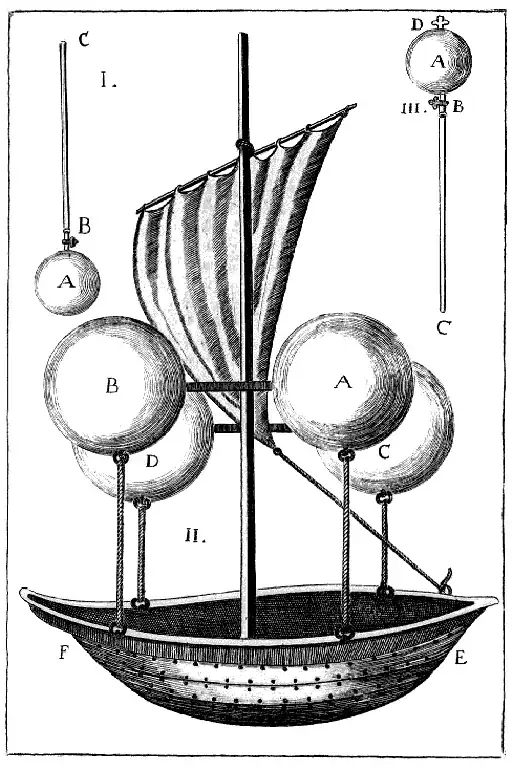
Given that in these ideal conditions it is not possible, it seems unlikely that a spring in a balloon would be possible. However, the Wikipedia article does leave open the possibility that if the wall of the sphere was not solid, for example if it was made of a honeycomb structure, then it may still be possible.
Update: Apparently the maths has been done to show this is possible in theory, but it's not clear if it has been successfully implemented.

