There are many reasons why highly monochromatic light, such as that emitted by a laser, is useful for delivering a large amount of power to a small spot.
First of all, incoherent light sources such as a lamp are extended sources which means that they are emitting light from a piece of material which takes up a finite amount of space. When focusing this light to a point, the focal spot is limited by the size of your source multiplied by the magnification of your imaging system. This may sound like a small effect, but if you want to focus the light to a spot size which is on the order of the wavelength ($~1\ \mu\text{m}$) it becomes important. Lasers, on the other hand, act like true point sources and can be imaged to spot sizes smaller than the wavelength of the light.
A second issue with incoherent light sources is that they generally emit light in all directions. So, even if you can generate an equivalent amount of optical power, it is much more difficult to gather it all up into a collimated source which is needed prior to focusing to a spot.
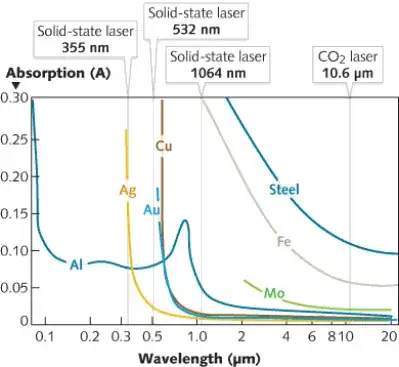
A final advantage of lasers is their monochromaticity. This is useful because the wavelength can be precisely chosen to match a particular application. CO2 lasers, for instance, emit at $10.6\ \mu\text{m}$; which is absorbed well in a wide range of materials but not all that well in metals. Nd:YAG lasers and its harmonics (the three wavelengths labeled as 'solid-state laser' in the image below) are, however, absorbed well in metals and can be used for metal processing. With incoherent sources the light is emitted over a broad range of wavelengths which may or may not exhibit desirable properties in the material you are trying to process.