If you have a prestressed concrete beam or slab and are jacking a cable from both ends, does the order of operations alter the result?
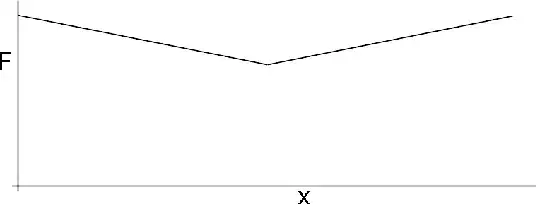
For a symmetric curve, the tension diagram along the cable's span after friction losses is always shown as symmetric.
Is this the case regardless of whether the ends were jacked simultaneously or one after the other?
If the ends are jacked simultaneously then the symmetric friction loss makes perfect sense. However, if the cable is jacked first from the left and then from the right, I'd expect the tension profile to be asymmetric.
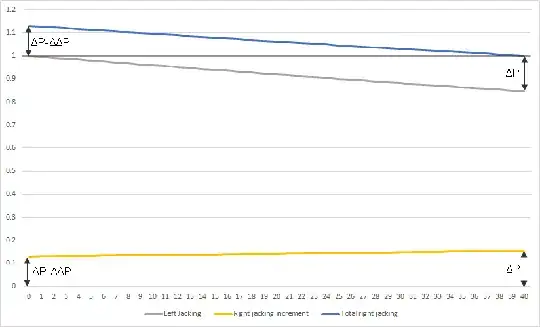
When jacking from the left, the cable is pulled and on its left end the cable force is equal to $P_0$, the jacking force. On the right side, the cable force is $P_0 - \Delta P$, where $\Delta P = P_0\left(1-e^{-(\mu\alpha+kL)}\right)$ is the friction losses. The left side is then anchored (disregard the anchorage slip losses for a moment). The right side is then jacked. Effectively, this jacking adds a force of $\Delta P$ to the right end, so that it too is now at $P_0$. However, wouldn't the left end also be affected with an increment equal to $\Delta Pe^{-(\mu\alpha+kL)}$, such that the diagram is asymmetric?
What about if one considers the fact that when the left side is anchored, anchorage slip losses occur? So the diagram should go: friction losses from jacking the left side, anchorage slip losses from anchoring the left side, friction losses from jacking the right side and then anchorage slip losses from anchoring the right side.
EDIT After a few honest-to-God minutes freaking out thinking I was the biggest idiot on Earth I realized that what @sanchises commented doesn't rule out my question.
The cable in my question does remain in static equilibrium, as can be seen here:
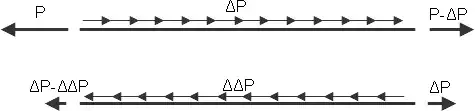
When jacking from the left, the cable suffers at its left extremity a force of $P$. Friction losses along the way ($\Delta P$) cause the right extremity to end up with $P - \Delta P$. The right extremity is then jacked, which effectively applies a force of $\Delta P$. Friction losses also apply here, now with a value of $\Delta\Delta P$, such that the left anchor is additionally jacked with $\Delta P - \Delta\Delta P$.
This results in the left anchor with a force of $P + \Delta P - \Delta\Delta P$ and the right anchor with only $P$. These are not, however, the only forces acting on the cable: the friction losses are what keeps it in static equilibrium. Globally, we have to the left $$P + \Delta P - \Delta\Delta P + \Delta\Delta P = P + \Delta P$$ and to the right $$\Delta P + P - \Delta P + \Delta P = P + \Delta P$$ both of which equal the total jacking force (first $P$ on the left and then $\Delta P$ on the right).