29

So I got myself questioning what could be worse for the driver... a collision of two identical cars at equal speed (frontal crash) or the same car with the same speed crashing through a wall? The first case I see it would double the impact, but also it will absorb the energy into the other car structure, otherwise, in a solid and rigid wall, all the energy would come back to the vehicle.

Which situation is worse for the passengers?

Chris Mueller
  • 6,456
  • 2
  • 29
  • 56

4 Answers4

31

From the point of view of the driver of a car, impacting another car is about as bad as crashing against an ideal wall (a wall with zero deformation whatsoever).

If there were a plane reflection between the two cars, then vs. Car would be exactly equal to vs. Wall (the contact points between both cars would all be on the same plane, due to reflection, so each car could be considered a wall for the other). But this plane reflection does not exist:
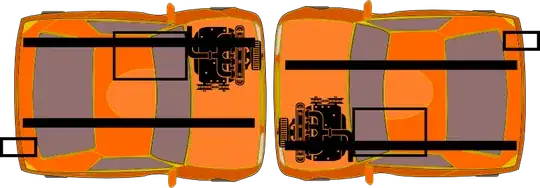
Cars crash from above

What we have instead is a 2-fold rotational reflection.

Let's say the left part of the car is heavier than the right part. The left and right parts will get crushed differently, with the left part of each car going further than if there had been an immovable wall. Heavy parts of each car will slide beside each other, with a lot of the energy absorbed by steel deformation, and a longer distance between point of impact and final point, thus lesser deceleration. In this scenario, if you happen to sit on the heavy side you are lucky, but if you happen to sit on the light side it might be worse than a wall.

Also, rather than all forces having the same direction, some of the energy will be converted into rotation, which can be either a good or bad thing depending on where you sit.

Finally, cars have a few hard structural beams (or parts that can be considered as beams) and most of the rest is softer. If hitting a wall, deceleration is immense as soon as a beam touches the wall. If hitting another car, the beams will probably enter the other car's soft parts. Here again, distance between point of impact and final position will be longer, thus a less violent deceleration. This is especially true at very high speed, with beams of each car piercing through most of the opposite car.

All in all, crashing into an ideal wall is probably a bit worse than crashing into another car, but better drive safely and avoid crashes :-)

Nicolas Raoul
  • 426
  • 6
  • 9
11

In the limit of the cars being identical and the wall being immutable, I would argue that the two situations are the same based on symmetry.

Consider the collision of the two cars with no wall. Conservation of momentum implies that the end result is both cars at a stand-still. If they hit each other perfectly head on, the vehicles will buckle and absorb energy identically.

Now imagine placing a completely inflexible wall between the two cars as they collide. Nothing about the situation changes; the cars still end up at a stand-still and absorb energy in the same way.

If you instead consider a wall which collapses when hit by the car, then hitting the wall is safer. Neglecting the added danger of flying bricks and a building on top of your car, that is.

Chris Mueller
  • 6,456
  • 2
  • 29
  • 56
6

I'm guessing you haven't seen the Mythbusters episode on this. Then, see this writeup that explains why they are correct, since Mythbuster's explanation leaves something to be desired.

In short, it's exactly the same. In the 2 car example, each car has the same amount of energy (as each other, and as the car in the 1 car example) since they are all going the same speed (and have the same mass). In the two car crash, the total energy in the crash is doubled, however, the energy is distributed equally between the two cars. Therefore, the energy for each car is identical to a single car hitting a ridged wall. The tests in Mythbusters illustrates this.

Paul
  • 2,579
  • 3
  • 26
  • 39
dberm22
  • 160
  • 1
  • 5
5

The answer will depend on the wall, and on the other car.

Consider the comparison to an ideal, immovable wall. In the case of a hypothetical collision between a Humvee (2500 KG) and a VW Beetle (850 KG), for the Humvee "vs. car" is better, whereas for the Beetle "vs. wall" is better.

Now consider the comparison to a paper thin, soft wall. For both the Humvee and Beetle "vs. wall" is better.

dotancohen
  • 272
  • 1
  • 6