4

There are high-rate anaerobic digestion systems where you remove substrate from the digester, let it settle in a tank, and pump back the settled sludge (possibly not all of it) to ensure a higher sludge retention time.

One problem with settling of sludge is that the forming of gas bubbles prevents settling. So before the settling tank, there's a degassing system. This is a basic PFD of such a process:
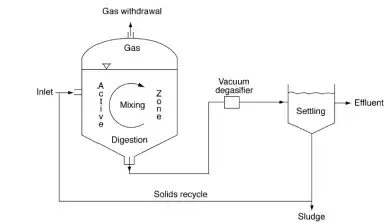
PFD of anaerovic contact process
Image source

How do these degasifiers work? What are their operating principles?

mart
  • 4,811
  • 2
  • 19
  • 32

2 Answers2

1

The most common degassing system I've seen use the same basic principles as an activated charcoal system (activated charcoal, set between two gas-housing plenums, in a non-reactive (typically fiberglass) structure). The pressure of the gas pushes the bubbles out through the filter, then to either a methane compressor or to a gas flare - in either case the hydrogen sulfide must be removed.

However, activated charcoal can sometimes absorb the methane - which is not desired. While you could rely on saturation to bring out the methane in an activated charcoal system or impregnate the carbon to not react with the methane, most system I've seen rely on iron oxide with a double displacement reaction between the oxygen and the sulfur to form fool's gold.

The iron oxide can be regenerated, as shown in the article - so when you design the pressure vessel, make sure it can be fully flooded to handle the regeneration load.

Air
  • 3,211
  • 4
  • 26
  • 47
Mark
  • 5,333
  • 16
  • 47
0

I've found one build myself (sadly lost the link): Reactor column with bed material, sludge flows through the column top down, the reactor is kept at a suitable underpressure. I don't know if and how the bed handles clogging by sludge.

Air
  • 3,211
  • 4
  • 26
  • 47
mart
  • 4,811
  • 2
  • 19
  • 32