1

If I have a flat span of steel material, 3.0m x 150mm wide and 5mm thick, and apply an increasing downward force to the middle, at some point it will fail.

But if the profile of that piece of steel was T shaped instead of a flat span, it is much stronger.

Is the Safe Working Load (SWL) for different profiles calculatable by a specific formula?

Assuming so, otherwise how could you design things like cranes, does the same formula apply to different materials e.g. aluminium v steel and different thicknesses of the same material?

grfrazee
  • 3,597
  • 1
  • 18
  • 33
Steve
  • 187
  • 1
  • 6

3 Answers3

4

In answer to the question Is the "SWL" for different profiles calculatable by a specific formula? - Yes, although it’s not one formula, there are lots of different things to consider, all with sets of formulae depending on the exact situation. Calculating Safe Working Loads (SWL) (or, indeed, starting from a desired working load and calculating the required structural member) is a large part of what structural engineers do.

A beam can “fail” in many different ways. Most likely for your given case would be exceeding the plastic capacity of the beam in bending, such that a hinge forms in the middle of the beam, causing significant deformation which then pulls the beam off one of its supports. The plastic capacity of a metal beam is relatively easy to calculate, you can use the formula

s = M/Z

where s is the yield stress of the material, M is the applied bending moment, and Z is the plastic section modulus of your chosen profile.

s is material dependant, so changing the material will change this. You can get various grades of steel, with yields from 230 to 260 MPa. Aluminium can be supplied with yields from 15 to 20 MPa.

M depends on the applied loading. In your case it is due to a force F applied in the middle of a 3.0m span, which gives a maximum moment of 0.75F. (Calculating bending moments is a whole separate topic).

Z depends on your profile. Wikipedia gives some formulae for some basic sections. (Calculating section modulae is a big topic too).

This formula will give your theoretical maximum load, and not your SWL. The SWL also takes into account factors of safety, which are used to ensure that the applied load doesn't exceed the capacity. There are design standards which specify these factors (which standards apply depend on the situation).

To answer your headline question “How much strength does adding a T piece add?” - it all depends on the dimensions of the T piece. And, as alluded to by grfrazee, as increase the depth of the T you run the risk of the failure method changing to lateral torsional buckling.

AndyT
  • 3,133
  • 14
  • 29
1

One can determine the section properties of a shape by using the parallel axis theorem, as is taught in an elementary mechanics of materials course. I have found the following website that will calculate the section properties of a T-shape when one inserts the proper input. Note that this website also lists the formulations behind the calculations.

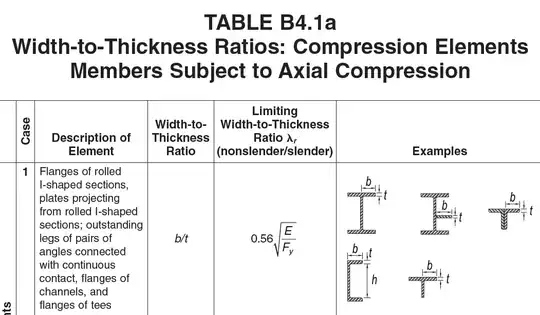
Yours could possibly have flange buckling issues given the slenderness of the flanges, but it's hard to tell without running any calculations. The following snippet from the American Institute of Steel Construction (AISC) 14th Edition Steel Construction Manual specifies the limiting b/t ratio that separated nonslender and slender compression elements. This may not be applicable depending in your jurisdiction since you are in Australia. However, the Australian Steel Institute should have a similar provision codified in its code.

enter image description here

The formulations for section properties of the shape are material-independent, so long as the material can be considered isotropic, homogenous, and elastic (steel and aluminum are, concrete is not).

grfrazee
  • 3,597
  • 1
  • 18
  • 33
-1

There are better ways of uniformly stiffening a plate e.g., by the Sandwich principle. A somewhat compromised version is the Isogrid, these are the distributed I-beams.

In both methods, effective bending rigidity is increased by making plate central parts hollow and so lighter in weight. Stresses are reduced.

Please google under these names. In place of 5 mm is a thick plate, you can use 1/8 inch plate and tack weld on isogrid cells or at least orthogonal ribs/grills of same 1/8 inch thickness, say 3 inch cell sizes. The webs are like bottle crates. Stiffness could go up by 4/5 times. The extra fabrication is worth it.

If alternate material choice is ok, even a 1-inch plywood sheet can be bonded with 1/16 thick steel sheets usind a good adhesive on either side for reduced deformation.

When improving designs, detail is important.

Narasimham
  • 287
  • 2
  • 9