How do the stators in axial compressors convert kinetic energy to pressure? Is this equivalent to a water hammer?
Asked
Active
Viewed 909 times

3 Answers
2
Compressors are a combination of rotors and stators along a structure with reducing cross-section area. The rotors spin and push air down the compressor, but due to their spin there arises a circumferential velocity component to the air flow.
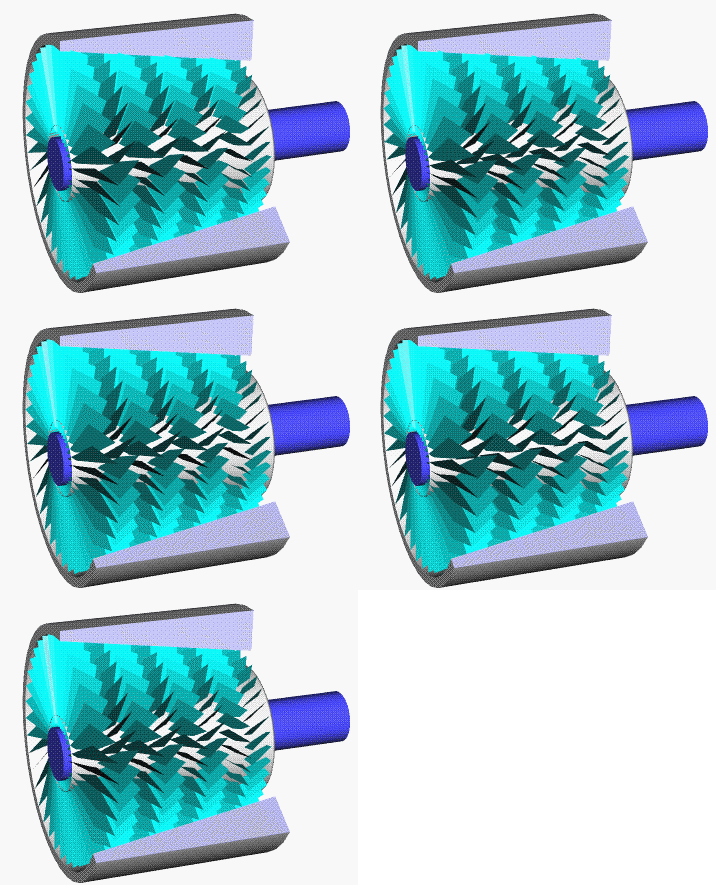
The stators don't revolve (hence the name) and they "straighten out" the flow, so as to direct the airflow to the next rotor set and achieve higher efficiencies without flow separation. But they still cause more compression because the cross section continues to get smaller and the shape of the blades reduces backwards motion by providing less resistance in one direction than in the other.

Maybe this might help you visualise the flow better? It's from aviation.SE but I don't know the original source

Suryetto
- 119
- 1
- 8
0
The stators will reduce the speed of stream of air but increase its pressure and density.
The flow's stagnation on the stators causes their kinetic energy to turn into pressure and help pack a lot more mass in the same space. Then the same air speed will carry a lot more air mass.
So the momentum mv, can be increased effectively increasing the thrust without the hassles of having to deal with supersonic stream and all the problems it would introduce.

kamran
- 23,517
- 2
- 22
- 42
0
Stators convert kinetic energy to pressure energy by decelerating the flow. The shape of the blades and the passage between the blades is such that the flow's kinetic energy is transferred to pressure energy. If you're interested in the aerodynamics behind it, I'd begin by looking at how velocity triangles and isentropic compression processes work (http://www.seitzman.gatech.edu/classes/ae4803/compressor_angles.pdf). If you're interested in the compression process, look at the temperature vs. entropy diagrams in the attached document. This shows what happens to the fluid as its compressed through a compressor stage (i.e. from point A to B). There are tons of documents out there describing the thermodynamics and aerodynamics of turbomachines such as compressors.

mechcad
- 523
- 2
- 7