6

How can I measure changes in liquid level of the order of 50 μm?

The tank is cylindrical with a radius of about 12.5 mm and a total volume of about 45 ml. The fluid is water-based. The technique needs to be optical or similar because no external body can touch the solution.

I looked at ultrasonic sensors but they don't seem to reach such high precision. Now I'm checking laser sensors as well, but it seems that they don't satisfy the required precision either.

Air
  • 3,211
  • 4
  • 26
  • 47
Worldsheep
  • 383
  • 1
  • 10

4 Answers4

3

If you are adding fluid at a constant rate a simple michelson interferometer seems like a possible solution. You should get a fringe every $\lambda/2$ m, so ~300 nm. As long as you can sample fast enough it is then just a case of counting the number of fringes to get the distance moved. The only difficulty I can see with this approach is low reflectance from you liquid surface, but that will be the same for any optical method and shouldn't be too much of a problem.

Ultrasound will be difficult as you need to measure time of flight to the ns level to get that sort of resolution. It may still be possible using a lot of averaging, but I would think its not worth it.

nivag
  • 1,035
  • 8
  • 14
2

I believe some laser equipment does have the 20µm that you are looking for:

Displacement measurement sensors

This product for example has a 20µm precision, but it is said that the precision depends on the optical properties of the surface, so it would require a test for your solution.

OD Mini - Compact, lightweight sensor for precise measurement

Also, another set of options is to measure properties of the liquid that are proportional to the volume of the liquid (supposing that the only variable of your experiment is the height and that the liquid composition, temperature, pressure or any other variable doesn't change). In that case you could, for example, measure the liquid resistance from one side of the cylinder to the other. However this would require a custom apparatus.

Another option that falls into this category (of using properties proportional to volume) is to use absorbance, putting a light sensor at the bottom at the flask and a light source at the top (or the inverse). In this case the precision is only limited by the precision of your apparatus. However a precision measurement might require a sophisticated apparatus (I don't know how the 50µm precision translates into complexity in this case).

And, as it was already mentioned, mass is another option. Coupling a reservoir to the cylinder which can be measured by a scale. If your experiment support this modification, I believe it is the easiest option, since precision scales are available at most labs.

Hope my answer provides some inspiration and please keep us updated on the results!

Wasabi
  • 13,167
  • 8
  • 39
  • 62
Odano Naotake
  • 226
  • 1
  • 3
2

(340.29(m/s))/(50 μm) = 6.8058 megahertz (or 146.933498 nanoseconds if you prefer) timing that tight is hard to measure on a micro controller, and requires a lot of knowledge to do on a micro processor, but certainly not out of the realm of possibility. That makes (ultra)sonics a possibility.

Capacitive sensors are the other method for things like this, but you said "no external body can touch the solution" so if that means a metal plate (coated in plastic if you want) can't be built into the container it won't work.

All that said, if its water based what are the effects of the meniscus on your measurement?

Sam
  • 123
  • 3
1

I suggest that you look at one of the follow three options.


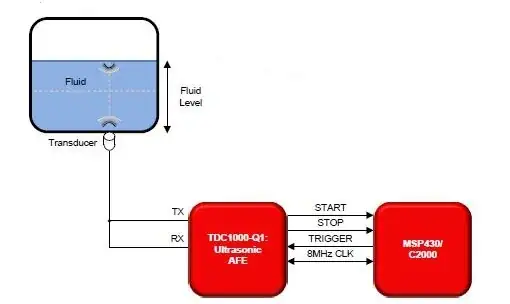
Ultrasonic Sensor for Texas Instrument (Option 1)

To measure liquid level from the bottom of tank one could use a piezo electric ceramic transducer combined with an Analog Front End (AFE) and a micro-controller to measure the liquid level. I believe with some additional work you can achieve your object. Check the references for more details.

Fluid Level Sensing

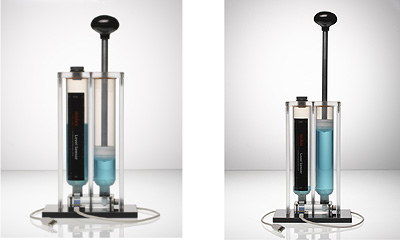
Capacitive Fluid Level Sensors from Molex (Option 2)

They have claimed that there system is capable of measuring very small changes. Molex still have to demonstrate there product to me. Either way it is over kill for my current project. If you happen to use them please come back and leave your feedback.

enter image description here

PSoC CapSense for Liquid Level Sensing for Cypress (Option 3)

This technology from Cypress is interesting. I have this as viable option for my current project.

Please refer to the references for additional infomation.


References:

Mahendra Gunawardena
  • 7,155
  • 6
  • 28
  • 68