3

I want to put LED lamps in water. Up until now I used epoxy glass for its isolation, but after one year it starts to become opaque and lose its clearness.

What causes the epoxy glass to cloud and become opaque? How can I avoid this problem while keeping the lamps isolated from the water?

hazzey
  • 10,730
  • 11
  • 46
  • 96
Soheil Paper
  • 297
  • 2
  • 11

2 Answers2

3

The wavelength of the light with the dissociation energy of epoxy phenyl oxygen is 300-310 nm. Over time, when exposed to this wavelength, it will become opaque and yellow.

The solution is simple: add a layer which absorbs strongly the UVa (it has a high absorptivity in these wavelengths), like oxanilidies, and this will inhibit the opaque degradation.

peterh
  • 2,394
  • 4
  • 30
  • 46
3

I would guess that your current epoxy changes its optical properties because of ultraviolet (UV) light coming from the LEDs. You may be able to find specialized UV-stable epoxies that don't suffer from UV. You could rethink your mechanical design and use a glass (or UV-stable plastic, or sapphire) window in front of the LED.

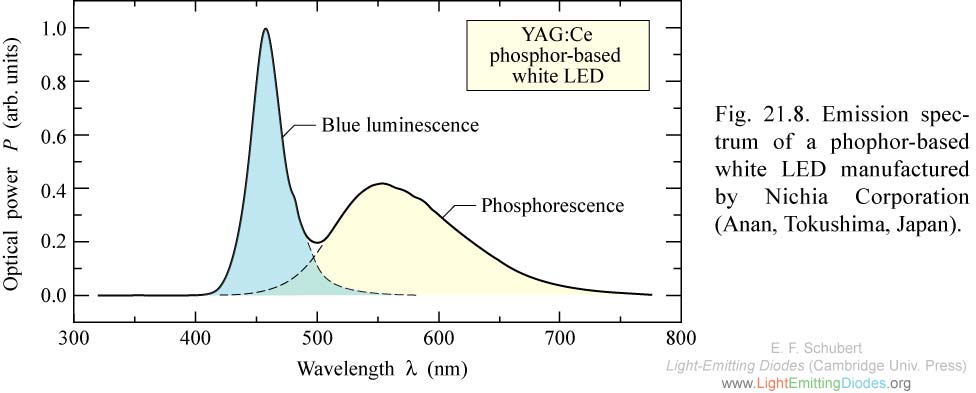
White LEDs are actually blue LEDs with additional phosphor (look at a spectrum below). The tail of the blue part can extend far enough into the short wavelengths to reach UV. If an LED is powerful and the polymer victim is close enough, then this residual UV can cause degradation over time.

enter image description here (source of the plot)

Nick Alexeev
  • 1,035
  • 1
  • 9
  • 20