0

The thickest plate of the famous Ever Given as an example with its 400 meters length is 30mm thick. And a good part of its skin is even thinner. If we compare with a car 2 meters long it is amazingly thin.

Well, the skin is thin and there is a considerable amount of stiffeners welded on the skin.

Why not thick walls? What is the disadvantage of having thick walls?

  • 4
    I believe the main concern is weight. Note that there are framing skeletons hidden behind the skin plate, so the length of the ship does not matter much but the spacing of the frames. – r13 Aug 03 '21 at 12:31
  • 4
    Cars are designed so that idiots can have a side on collision with a closing speed of 70mph and walk away from it. Ships are not designed to be driven by idiots. – alephzero Aug 03 '21 at 14:34
  • Also there are different specifications of steel . So less of more expensive, tough, strong steel is used in critical sections. And cheaper plate is used as a skin. – blacksmith37 Aug 03 '21 at 14:50
  • Why would it need to be thicker? Will the Ever Given have to deal with sea ice? A design needs to be as complicated as it needs to be to meet the design goals. Anything else is a waste. Is there any advantage to having thick walls? Vessel would be heavier, slower, consume more fuel. – StainlessSteelRat Aug 04 '21 at 01:47

5 Answers5

4

The simple most obvious answer is Weight.

And that additional weight would offer little to overall stiffness.

See this answer for an example of the marked effect that stiffeners may have on the behaviour of steel plates.

NMech
  • 24,340
  • 3
  • 38
  • 77
3

The loads asserted on the hull of a ship are shared between the hull plates and the internal ribs and bulkheads. Most of the flexural strength comes from the ribs and bulkheads.

niels nielsen
  • 15,513
  • 1
  • 15
  • 33
2

Ok, let me try to phrase in a way that even a layman that only has a few physics classes behind them can understand.

First lets consider torque for a second. Torque is defined as force times distance. Now in a big structure you have long distances, but also weight and weight is causing a force on the structure so that everywhere is straining the system. The more weight you have the more strength, but also more stress.

In a really big structure like Ever Given the more weight you put in the more support structure you need to put in, and the more support structure the more weight. Now there is some optimum in the lower end of the equation. You want to really minimize the weight of all of these or your costs will soon snowball out of control.

One last thing. Since weight grows based on volume and strength grows based on area. You couldn't just scale a car 100 times bigger, it would collapse under its own weight.

Transistor
  • 12,108
  • 2
  • 22
  • 32
joojaa
  • 3,691
  • 1
  • 17
  • 31
1

If you compare a car to an airplane, the airplane skin is extremely thin. A car's body is a major structural part of the vehicle which is designed for handling tough accidents, rollovers, etc.

A ship or airplane structure has to be designed with other priorities, such as weight, pollution of the environment due to excessive fuel to move the heavier ships or airplanes. The carbon footprint for manufacturing.

A car interior space does not permit the use of support struts, beams, braces, which would keep the structure strong while reducing the overall weight. While a ship or plane's large body has enough space for those braces.

kamran
  • 23,517
  • 2
  • 22
  • 42
1

The thickness of hull plates is goverened by regulatory agencies (DNV/GL, ABS, LR, BV, etc.). Outside hull is rolled alloyed steel shaped to minimize water resistance and internal is flat steel.
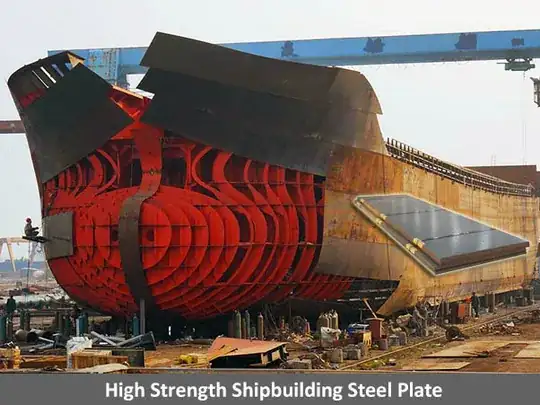
enter image description here

From Shipbuilding Steel Plates - Ansol Steel

Modern steel plates have much higher tensile strengths than their predecessors, making them much better suited to the efficient construction of large container ships. ... High corrosion resistant steel plate is perfect steel type for oil tanks, and when used in shipbuilding, ship weight is less for the same capacity ships, fuel cost and CO2 emission can be reduced.

From Steels for Shipbuilding

In shipbuilding, there is usually a trade off in the use of material and complex structures. Typically, a complex structure requires more labour and fabrication than a simpler structure, which uses more material. There is also a tradeoff between using more complex structure and the lighter weight of the vessel, as a lighter ship can carry more cargo for a given volume, requires less power and therefore fuel to operate. A lighter ship thus provides more revenue for lower operating costs. The simple structure and heavier ship, offsets these benefits by the lower construction man hours and thus labour cost.

The dimensions of the Ever Given:

  • Displacement 265,876 t
  • Length 399.94 m
  • Beam 58.8 m
  • Draught 16.0 m (maximum)
  • Depth 32.9 m

The displacement is the amount of water that is displaced by ship. Exceed that and ship cannot float.

Rough area of hull is 2 * 400m * 33m + 59m * 33m = 50,000 m^2

Additional mass = 50,000 m^2 * (251.2 - 235.5)kg/m^2 = 785,000 kg (roughly)

Numbers are from Shipbuilding Steel Plates - Ansol Steel

If we go from 30mm (235.50 kg/m^2) to 32mm (251.20 kg/m^2), the additional steel would decrease cargo capacity by 785 t. At 24t/TEU (fully loaded), this would be 32 less containers.

The displacement is fixed by the dimensions of the ship. Designers must balance everything which goes into the ship with water displacement. The hull: keeps the water out; resists wind and wave action (hurricane force); resist corrosion (with alloys, painting and cathodic protection). No matter how strong the hull is made, it will still be peeled away if made contact with rocks: Exxon Valdez and Costa Concordia or ice: Titanic. These accidents are not common.

Thinner plates makes shaping, cutting and welding easier but it means the ship is more flexible.

MOL Excellence - Bending of Underdeck Passage

StainlessSteelRat
  • 2,532
  • 1
  • 15
  • 20