As mentioned in kamran's answer its very important that the bar is rigid. Otherwise the following analysis is not relevant.
Although you don't seem to consider it this way, -if the beam is rigid enough-, then the fulcrum at the far left edge of the beam (not on B1, so the force there is not zero). The equation I derived is based on that assumption, which is more correct and will give slightly different results (the accuracy will depend on the beam's rigidity).
Below is an image of the side and top view of the beam (bracket to my mind has a right angle somewhere)
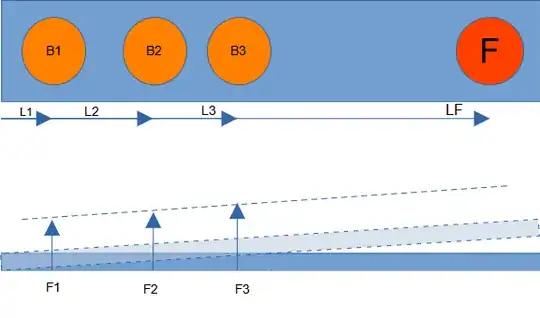
The top view (its at the bottom - I'm using a first angle projection), shows
- the undeformed with solid lines and
- the deformed position with light blue and dashed lines.
From there you can see that the displacement for each bolt, is going to be proportional to the distance of the bolt from the fulcrum. The fulcrum is the far left of the beam. Because the force is proportional to the displacement then the force on each bolt will be equal to:
$$F_i = K\cdot L_i$$
where:
- $F_i$ is the force on each bolt
- $K$ is the spring coefficient of the bolt (which eventually you need to calculate)
- $L_i$ is the distance of the bolt from the fulcrum .
Then you can write the equations for the equilibrium of moments about the fulcrum :
$$ F_1\cdot L_1 + F_2\cdot L_2+ F_3\cdot L_3 - F\cdot L_F =0$$
or
$$ \left(K L_1\right)\cdot L_1 + \left(K L_2\right)\cdot L_2+ \left(K L_3\right)\cdot L_3 - F\cdot L_F =0$$
if you simplify that:
$$ K \left(L_1^2 + L_2^2 + L_3^2\right)=F\cdot L_F $$
therefore:
$$ K =F\cdot \frac{L_F}{\left(L_1^2 + L_2^2 + L_3^2\right)} = \frac{L_F}{\sum_{i=1}^{3}L_i^2} \cdot F$$
Now that you have K, you can calculate :
$$F_i=K \cdot L_i$$
numerical example
This is to illustrate the difference, of selecting a different position to the fulcrum point.
if you assume the fulcrum is at B1, then you end up with (essentially the same with kamran's computation)
$$F_1=0 N, \qquad F_2= 326.86 N , \qquad F_3= 491 N $$
if you assume that the fulcrum is 100 mm to the left then the above values become
$$F_1=68 N, \qquad F_2= 297 N , \qquad F_3= 413 N $$


