31

According to google searches, the Jinping Underground Laboratories are the "deepest" building or buildings constructed, reaching 7900 feet (2400 metre) below the surface.... However, the surface in question is a mountain. While that does classify as underground, it highlights a flaw in the question of the deepest underground building.

I can't seem to find the lowest building in the world though, or the deepest in relation to depth within the earth's crust.

What is the lowest point below sea level that we have built where a human can go? I imagine this is likely another laboratory. But where would a building of this description be?

gerrit
  • 321
  • 1
  • 13
Chris Gergler
  • 413
  • 1
  • 4
  • 5

4 Answers4

35

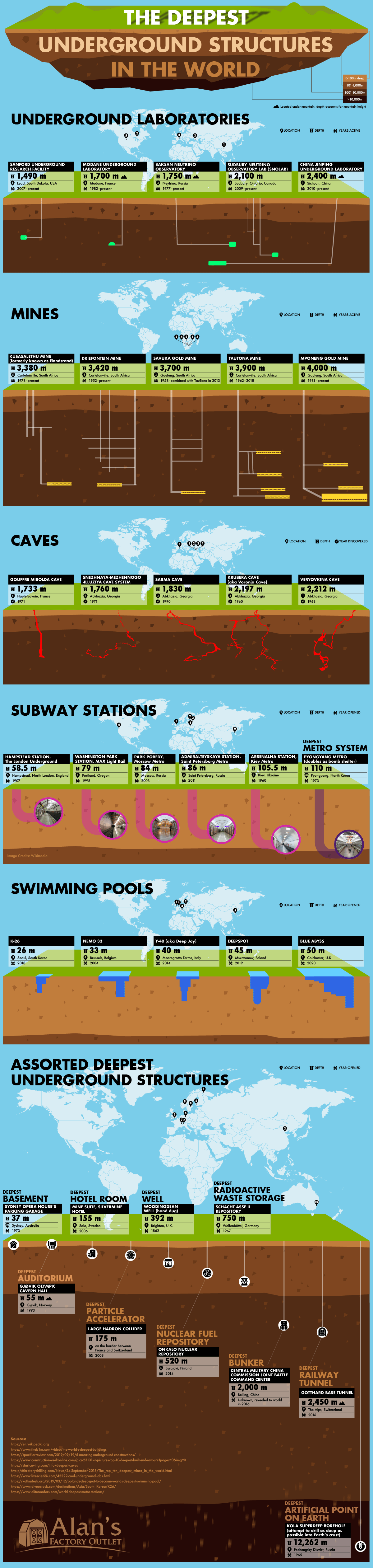
I assume you are asking the deepest structure of any sort that exists. Here is an infographic :

The Deepest Underground Structures in the World – AlansFactoryOutlet.com – Infographic Source : https://alansfactoryoutlet.com/the-deepest-underground-structures-in-the-world/

One mystery undersea structure:

Cuban Underwater City

The Cuban Underwater City is another underwater structure that raises more questions than it answers. What appears to be ruins of a submerged city with corridors and buildings including massive granite complexes, pyramids and circular structures is located off the coast of western Cuba as much as 2,000 feet (650 meters) below the sea level. According to the scientists, it would take about 50,000 years for the alleged city to be submerged to its current depth. As a result, many expressed doubt that the researchers from a Canadian company really discovered a lost ancient city in 2001. Unfortunately, sonar and underwater video robot images are everything that the researchers have so far about the site. Until more is known, it is impossible to say what is down there although the possibility that it is really a lost ancient city cannot be ruled out either.

https://historylists.org/other/list-of-5-most-mysterious-underwater-structures.html

Note: THe deepest descent in the ocean by human

"1960: Jacques Piccard and Don Walsh, with the deep sea vessel Trieste, descend to the bottom of the Challenger Deep in the Mariana Trench (10,740 meters/6.67 miles). They observe fish and other organisms. Fish were not thought to inhabit such deep water."

https://www.thoughtco.com/deep-sea-exploration-4161315#:~:text=1%20The%20deepest%20part%20of%20the%20Earth%27s%20oceans,of%20extra%20space%20above%20it.%20More%20items...%20

J...
  • 197
  • 6
r13
  • 8,333
  • 3
  • 10
  • 29
16

The Kidd Mine in Ontario, Canada: per the Wikipedia article, it is "the deepest accessible non-marine point on Earth" at "2,733 metres (8,967 ft) below sea level". I found this from the Wikipedia article on Extremes on Earth, which differentiates between depth from the surface and depth below sea level, and also between an actual mine vs. a bore hole.

user3067860
  • 286
  • 1
  • 3
15

If your volunteer is a very small person, maximum shoulder width of 23 cm/9 inches, then the answer is 12,262 metres (40,230 feet) deep in the Kola superdeep borehole in Russia.
I can't find the "height above sealevel of the start" to subtract from total depth of borehole, sorry. Best I can find is 230 metres above sea level.

They probably won't come out alive due to heat and lack of oxygen, but that was never stated as a requirement.

Temperatures were measured as 180 °C (356 °F) and the rock became too "plastic" to drill.

In free-air it would take around 220 seconds to fall this far based on 55 m/s terminal velocity of a human, but given the hole has a limited size, and the descending person has a width, there will be resistance to the air moving past. Plus any rising heat will act as a thermal, potentially lifting the descender. Additionally, friction with the side walls and any blockages will slow one's descent.

https://en.wikipedia.org/wiki/Kola_Superdeep_Borehole

Criggie
  • 450
  • 4
  • 12
4

The point you are looking for is very likely located in a mine. You could check the list of deepest mines by depth below ground, and then find and subtract the surface elevation for each. (This still assumes humans can go to the deepest points of these mines, which may or may not be correct.)

w123
  • 141
  • 1