3

Vertical Kaplan turbines are often used for hydropower plants. They can have an efficiency of more than 90%.

Vertical Kaplan turbine

Why don't we see similar designs for wind power? I mean one could imagine to redirect wind from horizontal to vertical direction and then let the wind go through a wind rotor. This would be similar to a https://en.wikipedia.org/wiki/Wind_lens, but in vertical direction. I imagine it could combine the advantages of horizontal wind turbines with the advantages of vertical wind turbines. Is it that redirecting wind from vertical to horizontal direction is so inefficient? Or are there additional issues with such a design for wind power. Update: So basically my question is: Why does a vertical Kaplan wind turbine have a much lower efficiency than for water?

asmaier
  • 131
  • 3

3 Answers3

3

Another reason, is that with hydroplants the water's natural motion is downwards, and its flow can naturally continue.

In the case of air the natural flow is horizontal. Diverting the air would be equivalent to a massive change in momentum and therefore very large forces on the duct structure. Also, as the air exited from the bottom it would need to change again direction (again very large forces and moments), and could also create other disturbances in the flow which would create vortices or other unexpected phenomena.

NMech
  • 24,340
  • 3
  • 38
  • 77
2

I am coming at this from the aspect of what I've read about propellers so I'm just focusing on the fact that there is a duct present; Forget the vertical and Kaplan aspects.

The problem with anything that involves a spinning blades surrounded by a duct is the duct limits the length of the blades. A properly designed duct does improve the efficiency of an airfoil by reducing tip losses for a given size. But just making longer blades also reduces tip losses and is more effective in improving efficiency. It's also easier, cheaper, and lighter.

So for a duct to have a net efficiency benefit, there usually has to be some constraint limiting the length of the blades, and this constraint has to be overwhelming enough to shorten the length enough that the duct can be of a reasonable size. In air, blades can be made so long that the size of the duct required to accommodate them becomes unreasonable.

For example, you do find situations in airplanes that limit the blade length: ground clearance, tips approaching the speed of sound, drag at high airspeeds. But ducts are never used because the duct is not of a practical size (or weight). The only time you see ducts are experimental aircraft, electric radio control models (for aeshetics since they actually perform worse than with a larger propeller), and on turbofans and turbines (but that is more because a combustion chamber is necessary).

It rather makes sense for hydropower plants in the ocean to use ducts since water is a much thicker medium and would result in higher stresses on the blades which limits their length. Water also also limits blade length so the tip speeds does not produce cavitation. If the length is limited to a point where a duct is of a reasonable size, then you add a duct and that just tends to not be the case in air.

DKNguyen
  • 5,659
  • 1
  • 13
  • 23
2

"Some manufacturers and inventors have made claims of exceeding the limit by using nozzles and other wind diversion devices, usually by misrepresenting the Betz limit and calculating only the rotor area and not the total input of air contributing to the wind energy extracted from the system."

https://en.m.wikipedia.org/wiki/Betz%27s_law

Betz law works for a free flow. Turbine you showed does not work in free flow to achieve the efficiency you showed, it works with a large vessel, that stops the water from just flowing all around the turbine. By Betz law you need to account all of that structure, not just thr rotor. Then efficiency will be comparable to what betz law suggests.

Why dont we build such turbines in free flow? Because they only work with a large concrete structure around it. That is costly. When alone, 'efficiency' will drop to well below of what Betz law suggests.

Why is it so? Because as you create larger pressure drop, more fluid goes around, and you loose power in a free flow. In restricted flow this is not an issue, flow doesnt get around.

We dont use such turbines in ocean free flow either. We use turbines that are very similar to wind turbines. They are optimal for a free flow, where fluid has an option to go around.

Also specifically your design: fluid will also just go through the intake horizontally, because flow is from one side, nothing will push it vertically, so it will not work in a whole new way as well.
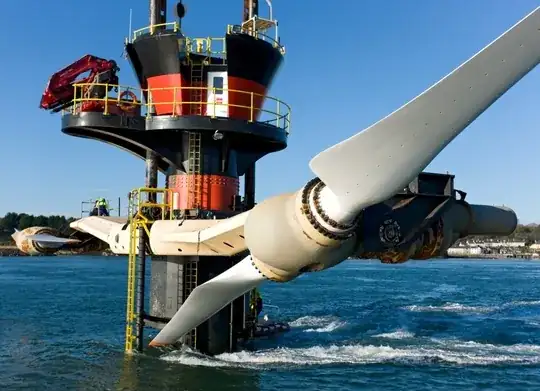
water turbine

P.S. it has nothing to do with fluid being gas or liquid. Its just that rivers of water are more common than rivers of air.