17

enter image description here

Why is a bridge designed like this?

The depth of the section at pillars is more than the depth at middle.

If I model this as a simply supported beam having load at mid span then the bending moment will be maximized at the middle and the area is also less at the middle. So, this will lead to higher bending stress.

So, why is it designed like that?

blahdiblah
  • 103
  • 1
MechaTrex
  • 405
  • 3
  • 11

5 Answers5

32

If I model this as a simply supported beam having load at mid span [...]

I suspect that this is where your analysis went awry.

First off, you should always model bridges with distributed loads, not a single concentrated load at midspan. The most significant load on a bridge will almost always be its own self-weight; load-trains are heavy but, well, so are bridges.

Secondly, I assume you're thinking of the bridge like this:
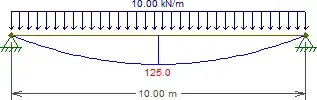
enter image description here

Indeed, we can see here that the bending moment is greater at midspan.

However, that's not the bridge we're looking at, it's missing the cantilevers! So in fact we get:
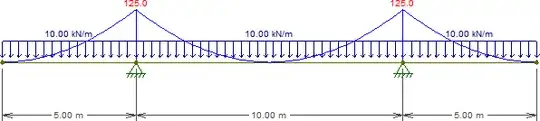
enter image description here

Now, I chose a midspan-to-cantilever ratio which exactly cancels out the bending moment at midspan. It's entirely possible that the real bridge has a positive bending moment at midspan, but it'll certainly be much smaller than the negative moment at the supports.

(the cantilevers might actually be supported at the ends; that would reduce the negative moment at the central supports and therefore increase the positive moment at midspan, but it'd still be much lower than if it were a pure simply-supported beam)

Obviously, the moment envelope from the load-train will have a positive component at midspan, but it won't be anything the thinner cross-section can't handle.


All diagrams created with Ftool, a free, educational 2D frame analysis tool.

Wasabi
  • 13,167
  • 8
  • 39
  • 62
7

Since this bridge is crossing over a waterway, besides aesthetics, the arch-shaped bridge provides several advantages:

  • Less restrictive over the height of marine traffic due to more headroom in the mid-span.

  • More dead weight is concentrated on the piers which makes the piers more stable.

  • Regarding your analysis, you have ignored the effect of the varying depth of the girders, and, most importantly - the "Arch Action". Due to the very large rigidity at the piers, we can assume the arched middle span is fixed on both ends, for which, the moment due to a concentrated load in the midspan is $\frac{3PL}{64}$, much less than the moment for a straight fixed end beam $\frac{PL}{8}$. Note, for the arch with pin ends, there is no moment, but thrust, throughout the span. (The moment comparison tends to give the arch another advantage - longer clear span.)

Note that The first two reasons usually are the controlling factors in the selection of types of bridges over the waterway.

r13
  • 8,333
  • 3
  • 10
  • 29
3

Spreading the upward reaction load from the support pillars is one reason, the function of an arch translating vertical load to horizontal thrust is another. But there are already good answers saying that.

There's another answer that isn't about structure : A lighter construction would be three arches - or one and two half-arches - of thickness d2, but there's been an assumption that traffic would probably prefer a level surface along the top than passing over three bumps (or two troughs).

2

Simply put, it is because the mass of the spans has to be supported and each pillar has to support 1/2 the mid span plus some of the end section.

Solar Mike
  • 16,242
  • 1
  • 27
  • 33
1

The bridge in the photo appears to be a post-tensioned concrete box girder balanced - cantilever. This is a 'continuous' structural form, meaning the spans are not simply supported, but are continuous over the tops of the piers. As pointed out in the digrams in one of the other answers, this will lead to large 'hogging' type moments (of opposite sign to the 'sagging' moments at mid-spans) over the piers.

Depending on how the cantilevers are balanced, the bending moments under dead loads may be designed to be effectively zero at the midspans (but not always designed this way). Under different live load conditions both hogging and sagging type moments may be experienced at the midspan, again depending on the design.

The bridge spans may have a shallow arched shape, but it is certainly not an arch in terms of structural action and there is effectively no 'arching action' - contrary to what some of the other answers have implied. To model or analyse it as an arch would be seriously incorrect.

To develop arching action the supports would require exceptional rigidity against longitudinal movement (even more so in this case since the 'arch' is very shallow). As it is, the leaf piers are relatively flexible and do not have anything like the necessary rigidity to develop arching action. Additionally, box cantilever decks of this form are usually supported on guided bearings at all but one of the piers/abutments. These bearings permit free longitudinal movement to release thermal and creep (and arching) effects.

PM-14
  • 171
  • 1
  • 9