22

What is the reason that handlebars are installed on motorcycles and steering wheels are installed on cars?

Notice that the way to use both handlebars and steering wheels are quite similar, but a steering wheel allows for much more rotation than a handle bar when you control a vehicle.

Please give me a reason why a massive vehicle should use a steering wheel and a light weight vehicle should use a handlebar?

The reason maybe involve scientific reasons, safety reasons or designing reasons.

Air
  • 3,211
  • 4
  • 26
  • 47
fronthem
  • 475
  • 4
  • 13

4 Answers4

27

Actually, handlebars and steering wheels are less similar than you might think.

When a two-wheeled vehicle is moving fast enough to balance, the front wheel is never turned more than a few degrees. The primary mechanism for steering is leaning the vehicle, not turning the front wheel.

For example, to turn right, you actually tug briefly on the left side of the handlebar. This causes the wheels to track to the left of the center of mass, which in turn causes the bike to lean to the right. This lean is what causes the direction to change, while maintaining balance — the total force on the bike's center of mass still passes through the contact patches between the tires and the road. During the turn, the front wheel is essentially straight with respect to the bike's frame, and it's the geometry of how the tires contact the road, aided by slight tension on the right handlebar, that keeps the bike turning.

To come out of the turn, you tug slightly more on the right handlebar (not the left), which causes the tires to track to the right, bringing them into a more vertical alignment with respect to the center of mass. This causes the bike to stop leaning and stop turning.

This is so intuitive when using handlebars, most people don't even think about the details of what's actually going on.

The only time you steer a bike by moving the handlebars by large amounts is when you are moving so slowly that you have one or both feet on the ground (holding the bike vertical) and are trying to maneuver in a tight space.


Additional points in response to comments:

An inexperienced bicyclist at low speeds will turn the handlebar wildly back an forth in an effort to maintain his balance, but I would hardly call that "steering". The main reason a 2-wheeled vehicle stays upright is the gyroscopic effect of the rotating front wheel. If the bike should start to lean, the wheel will experience a force that steers it toward the direction of the lean, which corrects the lean. If the bike is moving slowly, this effect is greatly reduced, and the rider is required to use the handlebar to maintain balance.

Also, on a bicycle, the rider is typically 90% or so of the mass of the system (bike + rider), and an experienced rider can steer merely by shifting his weight without touching the handlebar at all. On a motorcycle, the rider might only be about 25% of the total weight or less, which makes using the handlebar pretty much mandatory.

Dave Tweed
  • 7,273
  • 1
  • 22
  • 41
9

The car, being heavier, requires greater force to steer, which is provided by gearing the steering wheel down so that several turns are required from lock to lock.

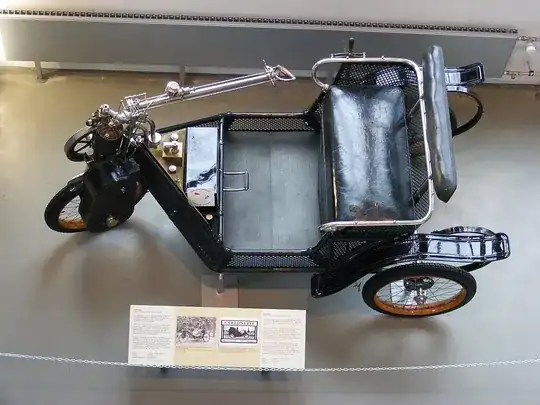
There were cars with tiller steering, inherited from yachting practice no doubt (only backwards), where the length of the tiller gave enough leverage instead.

I have no idea how their turning circle compared with their steering wheel contemporaries, or what sort of violence the driver did to a front seat passenger in the process, but the idea didn't exactly seem to catch on!

user_1818839
  • 1,640
  • 10
  • 11
5

When steering a car, depending on the degree of turn, sometimes it is necessary to rotate the steering wheel through a large arc. It is easier to do this using a circular steering wheel, particularly when the wheel has to be turned hand over hand. This cannot be done easily with semicircular steering wheels, aircraft type steering wheels or if handlebars where used.

The handlebars on a motorbike are rarely turned to the maximum arc angles that car wheels are turned. Also, on large radius curves motorbike riders use their body angle to lean into curves to assist steering. Car drivers however, only have the steering wheel to steer the car, moving their bodies doesn't do anything to the steering.

Motorbike riders are exposed to the elements while driving and they must balance on two narrow wheels and sit on a narrow seat. Slight turns of the handle bars can lead to graver consequences for motorbike riders than similar slight turns of a steering wheel in a car.

When holding onto the handlebars the rider forms one apex of a triangle which increases the stability of the rider. If motorbikes had steering wheels riders would not have the same level of stability they do with handlebars. Additionally, trying to steer a steering wheel while balancing on two narrow wheels is asking for trouble. It would decrease the stability of the rider as different muscles in body are used when turning handle bars to turning a wheel in the same plane; particular muscles in the torso.

The standard configuration for mass produced cars is four wheels on the ground, this a stable and balanced configuration. Also, car drivers sit on wider seats, compared to motorbike riders. Cars drivers are in a stable driving situation when they drive. It is easier for car drives to control a car using a steering wheel than it would be if they had to use handlebars.

Fred
  • 9,782
  • 13
  • 36
  • 48
4

gearing!

The amount of force required to repoint a car's front wheels at low speed is so high that there is a rack and pinion mechanism to allow it to be done by even a low-strength driver.

This isn't an issue with power steering - and there were some cars in the 1950s which had handlebars, HOWEVER it was discovered it was too easy for the driver to unintentionally make violent changes at speed

As with motorcycles, once a car is moving at speed, steering changes are minimal.

For this reason (safety), handlebar steering power-steering systems quickly stopped being used in cars in favour of a geared setup requiring large changes of wheel angle to effect changes of front wheel angle.

Safety is also why push-button automatic gearbox selectors were tried and then dropped. It's far easier to install lockouts on a lever to prevent cars being shifted from (D)rive to (R)everse whilst in motion.

With electronic systems, pushbutton selectors may make a comeback as complex mechanical interlocks are no longer needed and a solenoid will do the job.

It's also possible that with speed-sensitive steering systems and electronic control, a handlebar setup may be safely deployed - however it is so non-traditional that it would probably be a major insurance risk due to drivers making catastrophic errors at speed.

stoatwblr
  • 41
  • 1