11

All solar collector and boiler tank systems that I can find on the market use a liquid to circulate the heat between solar collector panels (or PVT panels) and boiler tanks. Is there a reason why they do not use expandable gas and a compressor instead?

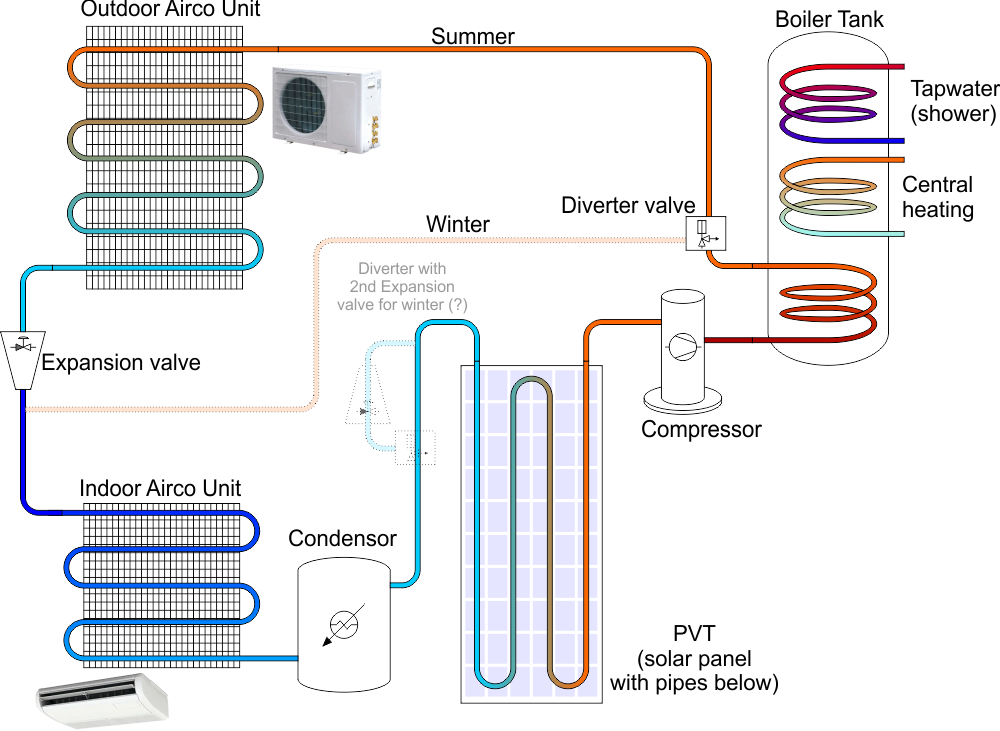
I was looking for an air conditioning system that would not waste excessive heat during the summer, or at least use it for preheating tap water.

This is what I came up with:

Combined heating cooling system

Since I'm a software engineer, this idea will evidently be full of "bugs" that need to be ironed out. But let’s start with the first most obvious question: Why don't boilers use gas instead of water (or even worse glycerine where freezing may be an issue)?

Louis Somers
  • 265
  • 2
  • 10

6 Answers6

17

Heat pumps work well to extract heat from one zone and discharge it into a zone at a higher temperature. The output of solar water-heating panels is generally much higher than the boiler tank temperature so a heat pump is not required and the added complexity adds cost, reliability factors and running cost.

Put simply, a heat pump is not required as the source is hotter than the load so the simplest and most reliable solution is to let the heat "run downhill" from the hot water to the cooler tank.

Transistor
  • 12,108
  • 2
  • 22
  • 32
5

The transmission of heat by phase change (liquid to gas and gas to liquid) IS used in some solar collectors.

These are the evacuated tube type and are the "Rolls Royce" equivalent when compared to flat plate collectors. They will collect more energy in the extreme conditions compared to any other collector, BUT they do cost more.

Solar Mike
  • 16,242
  • 1
  • 27
  • 33
4

You can't tie these two systems together because the demands on them are pretty much independent of one another. They each need to operate according to their own run schedule. The HVAC system runs based on demand since it has about 5 minutes of "storage" in terms of thermal mass vs temperature dead zone. The solar water heater runs when there is a positive temp difference and can be designed with storage to suit the occasion. Temperature mixing valves let you run the storage tanks 60 degrees hotter than the burner cut-in temps.

There are some niche cases where both sides of a heat pump can be used. Desalinators can mop up a lot of random heat to good effect. Paired hot tub and plunge tanks are another.

Phil Sweet
  • 5,224
  • 10
  • 20
1

I'm not quite sure what you meant by your question - about boilers using gas vs water. Are we talking about refrigerants being liquid or gas at a particular point in the cycle? circulating hot water for indirect water heaters? burning natural gas?

I'm actually tinkering with a similar concept - trying to use both ends of heat pump along with seasonal energy storage - (looking at insulating a tall, well-insulated tank to store cold, warm and hot water at varying proportions depending on season - making use of water's relatively decent insulation via thermaclines). I'm modifying a hot-water heat pump to replace the fan coil with a flat-plate exchanger to make it a water-water heat pump with a relatively small refrigerant circuit - and using plain water for everything else - heating, cooling, and wasting excess heat/absorbing heat as needed via an outdoor fan-coil using water. Fortunately, I'm at a frost-free location, but would think this could be adapted with sufficient storage if temperatures are often well above freezing for periods of time in winter. Quite a bit of work ahead still but happy to share more if there is interest (perhaps a different forum).

I don't think there is much to gain from adding a thermal plate to a PV panel - depending on the local climate and working fluid you would be dealing with a lot of connections and extra refrigerant (a hazardous material under pressure) + complexity and extra controls. But ignoring all that - in the circuit you provided, if you're using both the hot and cold ends of the heat-pump, it would add a bit more superheat on the compressor input which should raise its efficiency a bit to reach a high outlet temp. Running the panels a bit cooler also increases their efficiency. However, if you're mostly using AC with little hot water, you want the condensor as cold as possible for best efficiency - so you'd want to disable this much of the time.

Alternatively your PV-thermal-plates could run an additional loop of water/antifreeze - perhaps connected to a coil at the bottom of that tank to preheat incoming cold water. I would design that tank to directly circulate water via inlets/outlets at different levels, instead of being static with many different coils. You'd need a coil at the top for potable hot water - and also consider how to deal with any parts of the system that might freeze.

Note that your "condensor" is in the wrong place. It isn't a discrete piece of hardware, just the hot heat-exchanger on the output of the compressor (the outdoor fan-coil in a typical AC unit). The expansion valve keeps this side at high pressure, allowing the refrigerant to liquefy (condense) at a high temperature as it heats its environment. For example, if this heats your hot water, then as the water heats up, the refrigerant will end up being pumped to higher and higher pressures to reach a higher temperature, generally at lower efficiency and higher system stress. The system will have enough overall refrigerant to operate of the range of temperatures it is expected to manage.

Have a look at a heat pump cycle on a refrigerant enthalpy pressure chart to get a better idea at what happens during the 4 portions of the cycle.
M Szil
  • 21
  • 2
1

I was looking for an air conditioning system that would not waste excessive heat during the summer, or at least use it for preheating tap water.

A "[Heat Pump Water Heater][1]" works exactly like that. It uses a heat pump to transfer ambient heat to a hot water tank, cooling the room in the process. It might not be so great in the winter, for most people.

If you search for "solar air conditioner" (look at the pictures) you will find some products that use a solar thermal collector to warm up the outdoor unit of a heat pump that is used for heating, thus improving its efficiency. I don't know how well they work, but in principle they transfer heat from solar collector panels, using heat pump technology, as you asked.

As Ben Voigt pointed out in a comment, a pure PV panel that produces electricity that is used to heat up water via a heat pump approaches the efficiency of a thermal solar water heater and is more flexible because you can distribute the electricity to the usage you need, according to the season, or even lend it out to the grid. From what I read, current PV panels have efficiency of about 20% and heat pumps have efficiency 400% (COP=4) therefore a PV heat pump should reach 80% efficiency (transfer 0.8 kWh of heat to water from 1 kWh of received solar radiation). Where I live, pure thermal-solar water heaters are very common, and therefore much cheaper to buy and install -- about 1000 EUR, than a combined PV + heat-pump system. Having bought one myself, I realize that I throw away heat in the summer by not using enough hot water. The U.S. seems to have bypassed thermal solar water heaters and going directly to PV panels.

A Photovoltaic/thermal hybrid solar collector could add even more water-heating capacity, but it would suffer from the same excess heat problem in the summer that thermal solar water heaters have. [1]: https://www.energy.gov/energysaver/heat-pump-water-heaters

Fred
  • 9,782
  • 13
  • 36
  • 48
user13097
  • 111
  • 2
1

Heat pumps don't magically generate extra heat from a source, they just move it around, specifically we use them to move heat energy in the direction opposite to where it would normally move (from cold to hot).

When used for heating, they rely on the almost unlimited amount of heat available in the air as a source. They concentrate that heat into a small amount of fluid at a higher temperature. The total energy hasn't changed, just that some of it is now inside your house.

Solar thermal panels are a limited source of heat energy that's already hot enough. If you added a heat pump, you'd get a smaller amount of fluid at a higher temperature but the same amount of energy.

Robin Bennett
  • 171
  • 1
  • 5