10

I have a very basic understanding of how gears work, and while trying to learn more, I've run into a small point of confusion.

If a 2:1 gear ratio is achieved by having twice as many teeth on one gear than the other, then how are 250:1 ratios achieved? Certainly there aren't gears with 2500 teeth on one gear, and 10 on the other...

For example, here's a very tiny motor with a 250:1 gear ratio: DC Motor with Gearhead

user1586
  • 674
  • 4
  • 15
Soviero
  • 203
  • 2
  • 6

4 Answers4

8

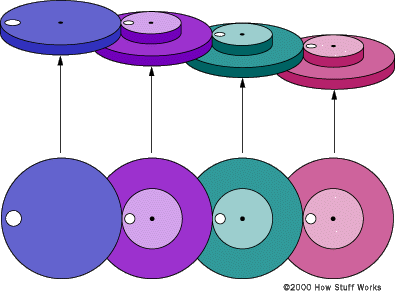
One simple way is to do the gearing in a number of stages in a gear train. Such a system uses gears which have two different gear sizes on the same wheel. In the example shown in the image below (from the How Stuff Works article on gear trains) each gear has a ratio of 2:1 such that the final ratio of the magenta gear to the blue gear is 8:1.

enter image description here

Chris Mueller
  • 6,456
  • 2
  • 29
  • 56
4

Using a worm drive you can have one tooth per rotation on one shaft and have that drive a gear with 250 teeth, for a 250:1 ratio in one stage.

Netduke
  • 1,099
  • 5
  • 7
4

Planetary Gear Sets can provide a high reduction in a small space. Also, they can be connected in a similar fashion to gear train to further increase the reduction. Also, one benefit is the output shaft is co-axial with the input shaft.

GisMofx
  • 1,588
  • 12
  • 19
1

What determines the gear ratio is the ratio of input and output angular velocities. This is traditionally done by interlocking different sized circles together, but for high gear ratios other designs are often used because they can reduce the output angular velocity sufficiently without needing several stages of gears interacting. One of the most ingenious examples is the harmonic gear. There are plenty of videos of how they work on Youtube.

https://www.youtube.com/watch?v=bzRh672peNk

Brian G
  • 111
  • 2