39

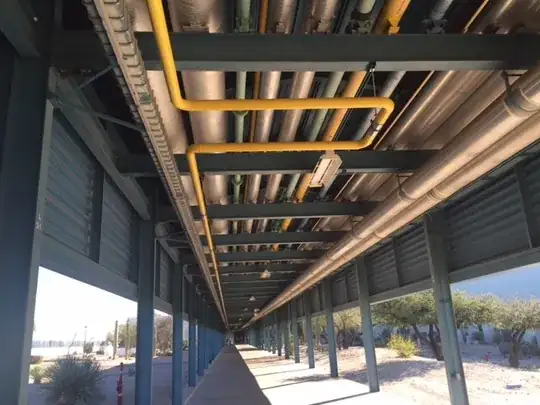
The campus where I work has a long covered walkway (~.5 mile) which has several labeled pipes running under the roof (chilled water, fuel oil, air...). All of the pipes run dead straight except for the natural gas lines, which have little loops spaced about every 250ft, as seen in the attached image (the lowermost, yellow line. There's another natural gas line hidden above all the others, which also does the same thing.)

The line isn't branching at these points, and there doesn't seem to be any need to divert the pipe in order to support it. I've looked at some building codes to see if I could find a reason (or even a requirement) to insert these.

Any ideas as to what these are? It's driving me batty!
enter image description here

Fred
  • 9,782
  • 13
  • 36
  • 48
Gretchen
  • 493
  • 1
  • 4
  • 5

2 Answers2

36

The loops are known as expansion loops. They need to be placed in pipelines to enable the pipelines to contend with thermal expansion and contraction and other forces that can affect the pipeline.

They are typically placed in gas pipelines, irrespective of when the gas is hot or cold - natural gas or steam.

The following quote is from Pipeline Design. It's near the end of the page under Pipe Expansion and Supports

Steel piping systems are subject to movement because of thermal expansion/contraction and mechanical forces. Piping systems subjected to temperature changes greater than 50°F or temperature changes greater than 75°F, where the distance between piping turns is greater than 12 times the pipe diameter, may require expansion loops.

Such loops are not only used in gas pipelines and are used in pipelines that convey other fluids such as oil. Pipes transporting liquid fluids can use other expansion control devices such as single slip expansion joints or bellow type expansion joints.

Accommodating Thermal Expansion in Pipes

Pipeline Safety

Ben Trettel
  • 996
  • 1
  • 5
  • 12
Fred
  • 9,782
  • 13
  • 36
  • 48
1

If the other pipes are carrying liquids with a greater specific heat coefficient then they would not be expected to experience the same temperature ranges, i.e. the water pipes will be at some average of the outside temp and the water temp. A low-pressure gas line would be made of lighter material and the gas inside would equalize with the external temp pretty quickly. So the code for a gas line and a liquid line (or a light pipe and a heavy pipe) might be different.

Expansion joints are often used for exposed liquids pipelines, like the Alaska pipeline, that are subject to temperature extremes and cover long distances. Buried pipelines don't experience the same range of temperature and don't normally employ expansion loops.