12

The TurkStream project site claims the gas pipeline will use pipes made from 39 millimeters of high-quality carbon manganese steel with additional plastic coatings on both sides. Yes, they claim 39 millimeters (roughly 1,54 inches) of steel walls - that's a whole lot of steel! For comparison, the M41 Walker Bulldog light tank had only 38 mm of armor plating.

Is such wall thickness realistic for an industrial gas pipeline? Why would you need that much steel for a gas pipeline?

Air
  • 3,211
  • 4
  • 26
  • 47
sharptooth
  • 2,129
  • 19
  • 28

4 Answers4

19

It seems realistic to me. This is an undersea pipeline at depths of over 2 km. The pressure would be considerable at those depths (on the order of 20 MPa or 200 atmospheres). The pipe would need to be thick enough to withstand these (very high) pressures.

The Nord Stream pipeline under the Baltic sea is at depths of up to 210m and uses 1220 mm diameter pipe with a wall thickness ranging from 26.8 to 41 mm. The TurkStream site specifies depths more than 10 times this, but with a pipe diameter of 813 mm. Without doing any calculations that seams reasonable.

Undersea pipelines are known to have wall thicknesses of up to 75mm

atom44
  • 2,661
  • 13
  • 29
13

Is such wall thickness realistic for an industrial gas pipeline?

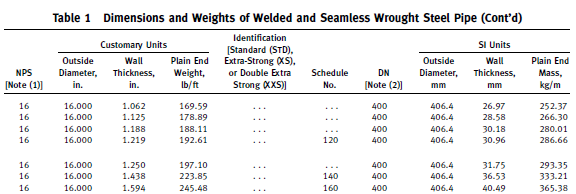
Looking through ASME B36.10M-2004, Welded and Seamless Wrought Pipe, there are plenty of pipes that have thicknesses in that range. For example, 16" diameter, Schedule 160 pipe is 1.594" thick:

ASME Table 1

This translates to about 40.5mm thickness. As another extreme example, 24" diameter, Schedule 160 pipe is a whopping 2.344" (59.5mm) thick!

As @mg4w says, the pressures at play for some of these pipelines can be enormous, so the pipe wall needs to be commensurately thick to withstand those pressures.

Note that per Section 1 of ASME B36.10M, it "covers the standardization of dimensions of welded and seamless wrought steel pipe for high or low temperatures and pressures." That's not to say that pipe cannot be made with thicknesses outside of the ranges in the standard, which is likely the case for some of these heavy industrial applications.

grfrazee
  • 3,597
  • 1
  • 18
  • 33
3

Why would you need that much steel for a gas pipeline?

Remember that the force on the inside of a pipe is proportional to pressure*diameter. So a large pipe needs to be much thicker than a small pipe for the same pressure.

Chris Mueller
  • 6,456
  • 2
  • 29
  • 56
Peter Green
  • 189
  • 5
0

Because of work conditions of pipe (fluids or gas, lifespan, pressure inside the pipe...), and I think that was calculated by design engineers and the result accordance with application code/standard. For the tank you should not compare like this because work condition and application code/standard not the same. When repairing or maintaining the pipe, it is much more difficult.