7

I come from a mathematics background and I'm familiar with laplace transforms in-as-far-as they provide an algebraic method to solve ordinary differential equations.

So, when I read about transfer functions, I can clearly see the one-to-one correspondence between the poles of a transfer function and the eigenvalues used to solve the homogeneous ODE. But I'm rather confused as to why the zeros of the transfer function are of particular interest to control engineers. If we're ultimately interested in stability of the system, why even bother with the zeros of the transfer function? The poles seem to tell you everything you really need to know. Does the location of a transfer function's zero with respect to its poles matter in some way? More importantly, how does their existence (or lack there of) affect how we design a suitable controller?

Paul
  • 2,579
  • 3
  • 26
  • 39

3 Answers3

5

Zeros are very important when you are looking at how to control a system. A good way to look at this is to examine a root locus plot. There are several rules on how to sketch a root locus, but the basic idea is to first plot the poles and zeros of the open loop system on the real-imaginary plane.

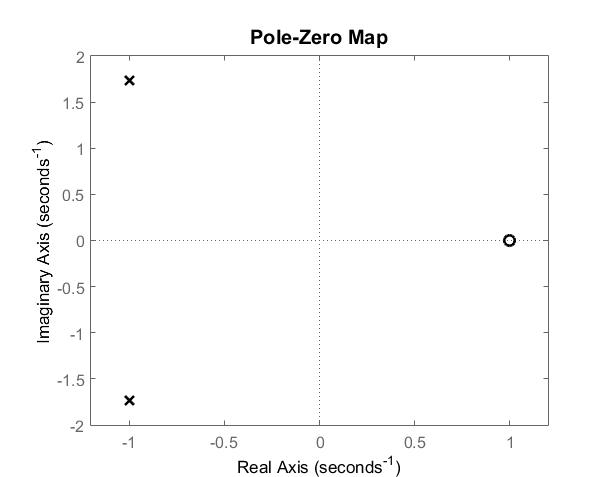
Take this system as an example (code for matlab):

G = tf([1 -1],[1 2 4]);
pzplot(G)

You can see in this pole zero plot, there is a stable complex conjugate pair of poles and a zero in the right half plane.

enter image description here

You already know that the poles are the eigenvalues of the system, and become the defining factors of the system's behavior (you can have distinct real, repeated real, or complex conjugate pairs). But what the root locus does is it asks: "What will happen to my system's poles if I try to apply feedback with a certain gain?"

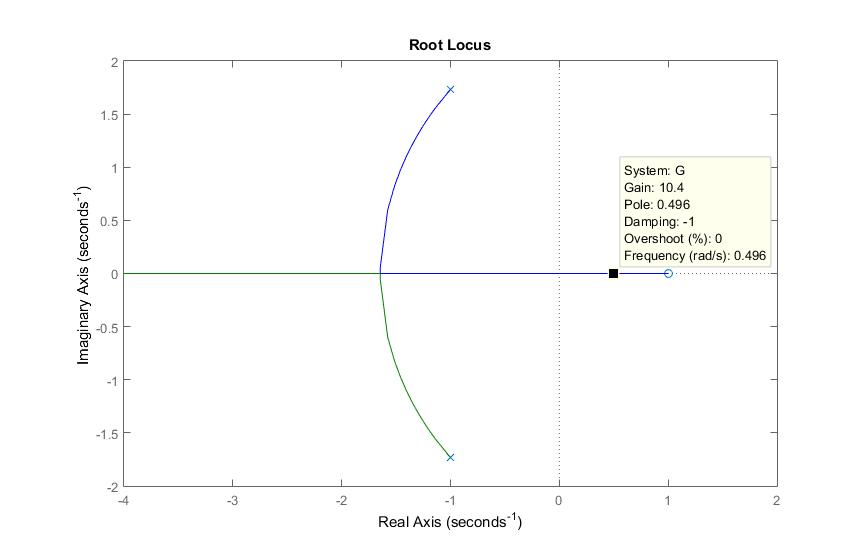
Following the rules of sketching a root locus, you'll get this:

enter image description here

What this shows is where the poles of the system are when you increase the feedback gain. What do you notice about one of the poles when the gain is 10? The system has an unstable pole.

The moral of the story: when you want to apply feedback control, as you increase the gain, the closed loop poles will start at the open loop poles for low gain and then move towards and terminate at the open loop zeros as gain increases. Therefore a controls engineer cares deeply about the zeros of a system. This is true for SISO systems, life gets more complicated for MIMO systems.

Please beware of what Olin said about pole-zero cancellation. This is only "true" in mathematic land. Pole-zero cancellation is not really possible.

willpower2727
  • 725
  • 4
  • 12
2

You can think of poles as low pass filters and zeros as high pass filters. They are in some way two sides of the same coin. You can't decide stability solely by looking at poles, any more than solely looking at zeros. For one thing, a zero can be used to offset the affects of a pole, or the other way around.

Each has the opposite affect on the response to frequency and phase shift.

Added

I see there is some discussion about the concept of poles can be used to offset the effects of zeros. As Willpower points out, zeros don't directly cancel poles, and I fixed my statement above to not say so. However, some combinations of poles and zeros can, over some range, offset the affects of other poles and zeros.

Consider the transfer function of old vinyl records. The information in the grooves was deliberately high-pass filtered, then the inverse of this filter applied in the playback circuit to ideally get a flat frequency response from original signal to final reproduced signal. There were various poles and zeros in the system along the way, some unavoidable due to the process, others deliberately introduce, and other poles and zeros applied to offset them. In this case, the ideal net result was a flat transfer function over the audio range. For more information on this, look up something called the RIAA equalization curve.

You would get a very wrong idea of the overall system by looking only at the poles and not the zeros, or just the poles and zeros in just the playback amp, for example.

Olin Lathrop
  • 11,461
  • 1
  • 24
  • 36
2

I would refer you to "Poles and Zeros of Linear Multivariable Systems: A Survey of the Algebraic, Geometric and Complex Variable Theory", A. G. J. Macfarlane, N. Karcanias for a very detailed analysis of zeros.

In picturesque terms, poles can be thought of as system resonances coupled to input and output, and zeros as associated with anti-resonances at which propagation through the system is blocked.

For example, sending an exponential input $e^{3 t}$ through the system $\frac{s-3}{s+1}$ results in the output $e^{-t}$. The system blocked an input that was blowing up, and the output decays to zero!

And there are many notions of zeros: transmission, decoupling, invariant, and system. These definitions work not just for scalar systems, but for multivariable systems as well.

Air
  • 3,211
  • 4
  • 26
  • 47
Suba Thomas
  • 2,036
  • 11
  • 15