5

How come axial compressors always narrow and turbines always widen towards the rear? From what I know:

  • The speed of sound of air increases with temperature, therefore increases (decreases) as it goes through the compressor (turbine).
  • The compressor and turbine blades at each stage should be meeting the air at just below the local speed of sound (more precisely critical Mach number).
  • The rotational speed of all stages of a given spool is constant.
  • The cross-section through which the air is flowing is $\pi(r_e^2-r_i^2)$, where $r_e$ and $r_i$ are the exterior and interior radii, respectively.

So shouldn't compressors widen and turbines narrow towards the rear, with the interior varying more than the exterior? And shouldn't turbines be much larger (~2x) than the compressors they drive?

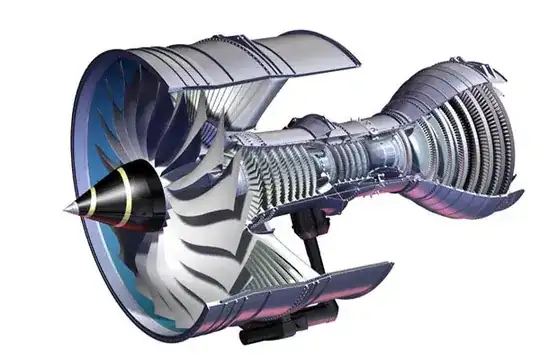
You can obviously see civil engines don't look like this:

RR Trent 1000 (Courtesy of aviationgazette) RR Trent 1000
GE GEnX (Courtesy of www.mikejamesmedia.com) GE GEnX
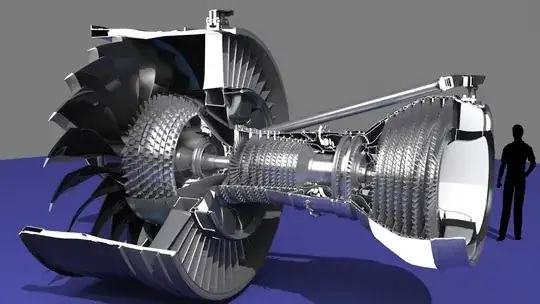
Anything I'm not taking, or taking too much, into account in my analysis?

Glorfindel
  • 279
  • 1
  • 5
  • 11
setun-90
  • 124
  • 10

3 Answers3

3

The compressor is compressing the gas, so the same amount of air (on a mass or molar basis) occupies less volume. If the goal is to keep the velocity approximately constant, the cross sectional area has to get smaller.

Mark
  • 1,031
  • 9
  • 10
0

Note that there are multiple physical constraints in the design. Unlike in a turboshaft engine, in a turbofan, the torque of the turbine spool has to match the torque of it's associated compressor spool. Also, the axial load on the two spools must largely cancel, because thrust bearings are a pain in this environment. Balancing these requirement puts a severe crimp on the relative size of the two spools.

Next, you have the problem of managing tip losses overall. Tip losses account for as much as 1/3 the aerodynamic losses in the machine. Low hub ratio designs minimize tip losses. Better tip design has allowed more efficient cascades and bigger hub ratios, but you still need a clearance that works for the entire spool. This tends to limit how much the hub ratio can vary over the stages of a single spool.

And you also want to minimize the surface area of anything that requires cooling. Cooling stuff robs efficiency.

Phil Sweet
  • 5,224
  • 10
  • 20
0

The most probable explanation why gas generators aren't designed the way I proposed is because they are designed around a constant air speed, not Mach number.
Maybe, in current compressor (turbine) stages, the rotors (stators) accelerate the air too much for the stators (rotors) to slow down, thus the external radius decreases (increases) to compensate and keep the relative air speed at the next stage constant.

setun-90
  • 124
  • 10