1

This is from a fake test before the real exam. It's a course which goes through Cisco academy - a course in networking.

  1. Use the address space 10.10.16.0/24 to design an addressing scheme. a) Split the address space into two equal-sized networks by subnetting it again.

I consider the question a bit unclear, for instance "subnetting it again". I guess they mean VLSM?

I have really tried to subnetting with VLSM this packettracer network but I always fail.

It's a network 10.10.16.0/24 that is to be subnetted effectively into two equal networks, that is not wasting any addresses. (VLSM). There are one router that is to be configured with the new parameters which should be applied to the router interface g0/0 and g0/1. There are two switches and two computers. See the image.
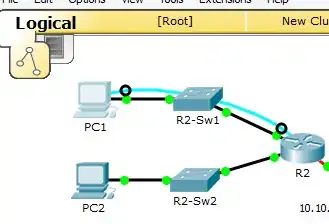
enter image description here

I have tried to first borrow 3 bits from 10.10.16.0/24 taking the new network 10.10.16.32 and subnetting that again taking two bits so I lastly get a 10.10.16.40/29 network.

This is now I got network 1 and I calculated network 2 to 10.10.16.48/29.

So - then packettracer wants me to take the first and last hostaddress for the router interface and the pc-computer. I did so, and yes, the PC:s can ping the default gateway and each other. But I fail completely according to the answer.

Björn Hallström
  • 297
  • 1
  • 4
  • 11

1 Answers1

3

Subnetting will always be a "2n" bit-wise operation. Subnets fall on specific bit boundaries, no matter what. You can't subnet on arbitrary boundaries or addresses. Just think, "always equal proportions." Not any different than cutting a pie into equal proportions.

I always use a /24 as a "base" to start from. Again, this is a 2n (ie multiply or divide by 2) operation, so you go from a single subnet, to two halves, or four quarters, or eighths, sixteenths, etc.

If you split a /24 into two halves, each one of those halves will be a /25 subnet.

If you split a /24 into four quarters, each one of those quarters is a /26 subnet.

If you split a /24 into eighths, each eighth is a /27 subnet.

The converse is true when going in the opposite direction.

If you combine two /24's into a single subnet, you end up with a /23.

If you combine four /24's into a single subnet, you end up with a /22.

If you combine eight /24's into a single subnet, you end up with a /21.

To answer your question, if you split 10.10.16.0/24 into two equal-sized subnets, you end up with:

1. 10.10.16.0/25
2. 10.10.16.128/25

The first and last usable from each subnet would be:

1. 10.10.16.1/25 and 10.10.16.126/25
2. 10.10.16.129/25 and 10.10.16.254/25

Hope this helps.

John Jensen
  • 9,077
  • 4
  • 31
  • 47