4

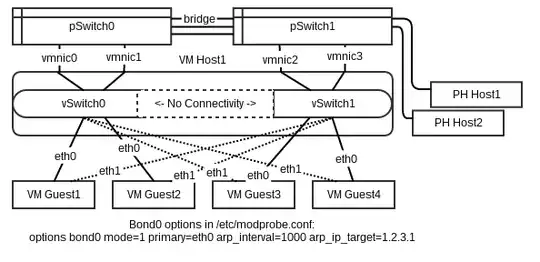
I have some servers in this configuration:
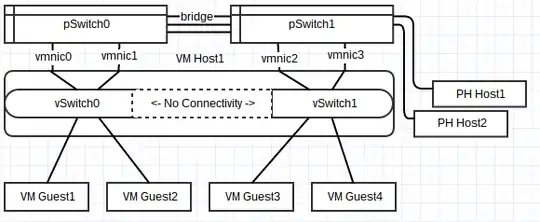
Diagram of VMWare ESXi Network Configuration

(complete configuration) enter image description here

And I am not able, from VMGuest1, to ping either VMGuest3 or VMGuest4. I can, however, ping Host1 and Host2, which are attached to pSwitch1. The behavior is the same with VMGuest3 or 4 trying to ping VMGuest 1 or 2.

I don't have promiscuity enabled for any of these switches, nor do I have a bridge set up inside ESXi for the virtual switches. I know that one of these options is usually necessary when trying to get connectivity between two virtual switches. These switches are connected, however, through their respective physical switches which are bridged together.

Ping just times out, arp request looks like this: [root@vmguest1:~]# arp -a vmguest3 vmguest3.example.com (1.2.3.4) at <incomplete> on eth0 [root@vmguest1:~]# arp -a host1 host1.example.com (1.2.3.5) at 00:0C:64:97:1C:FF [ether] on eth0

VMGuest1 can reach hosts on pSwitch1, so why can't it get to hosts on vSwitch1 through pSwitch1 the same way?

ewwhite
  • 201,205
Aaron R.
  • 467
  • 1
  • 9
  • 21

2 Answers2

3

Bonding your NIC connections inside of a virtual machine is akin to using software RAID inside of a VMware guest. You can do it, but it's not a reasonable method of protection for a VMware system.

Are you using managed switches?

I'd recommend simplifying your solution:

  • Place your VMs on the same vSwitch if they need to communicate with each other.
  • The uplinks from the vSwitch can go to one or more physical switches.
  • Ideally you can set up a stack between the physical switches, with vSwitch uplinks to each, but even a resilient bond between the physical switches (2 x 1GbE) will do the job.

That's really it... Is there something wrong with a configuration like:

enter image description here

or the more complex design described at: vSwitch configuration with 12 uplinks

ewwhite
  • 201,205
0

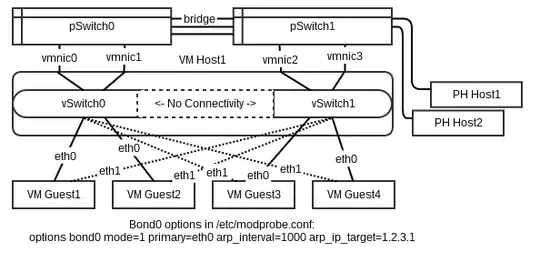
So this is your setup:

enter image description here

A bit complex, I would advise you to not do NIC bonding inside your VMs.

Anyway: Both vmguest1 and 3 can ping host1 but not each other, right? To investigate this, start by issuing

[root@vmguest1:~]# arp -a vmguest3
vmguest3.example.com (1.2.3.4) at <incomplete> on eth0
[root@vmguest1:~]# 

and use tcpdump to see what's actually arriving and leaving your vNICs. Does the ARP request reach vmguest3? Does it answer on eth0, eth1 or both?

Mario Lenz
  • 1,632
  • 9
  • 13