8

These days I've been learning a lot about how different scientific fields are trying to move their data over to the Semantic Web in order to "free up data from being stored in isolated silos". I read a lot about how these fields are saying how their efforts are implementing the "visions" of the Semantic Web.

As a learner (and from purely a learning perspective) I was curious to know why, if semantic technology is deemed to be so powerful, the efforts have been around for years but myself and a lot of people I know have never even heard of it until very recently? Also, I don't come across any scholarly articles deeming "oh, our inferencing engine was able to make such and such discovery, which is helping us pave our way to solving...." etc.

It seems that there are genuine efforts across different institutions, fields, and disciplines to shift all their data to a "semantic" format, but what happens after all that's been done? All the ontologies have been created/unified, and then what?

Dark Templar
  • 6,323

2 Answers2

5

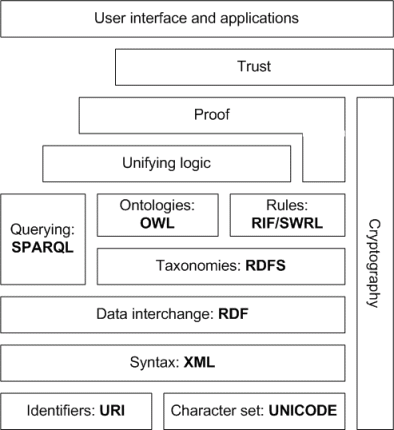
The different technologies of the Semantic stack/cake are trying to solve different problems: Some of them are more flexible but less structured (for example XML), while some others (RDF, OWL) are more rich regarding the structure and semantics of metadata.

I agree with you that the Semantic Web (as such) is mostly used in academia, but individual parts of the Semantic stack/cake are also used in the industry: XML for creating meta-languages, RDF in compilers, OWL for creating ontologies used in medicine, food and drink industry, etc.

To answer you last question, for taking advantage of the data described using Semantic Web technologies, we need tools that are aware of them. Tim Berners Lee describes "Semantic Web agents" as automated tools that can interpret the RDF/OWL contents of Web Ontologies and make inferences about them.

The main problems of the Semantic Web IMHO are: (1) The non-intuitive syntax of its languages, (2) Programmers/Companies are not motivated to use Sematic Web technologies, (3) There is a lack of good Semantic Web tools.

I find ideas like microformats easier to use and perhaps that's a good start for enriching raw data using metadata.

sakisk
  • 3,397
3

Dont agree one bit with the answer from faif. Basically state of SemWeb is as follows:

  1. The really useful standards have only gone into recommendation quite recently. SPARQL 1.0 wasn't that useful, SPARQL 1.1 is UBER powerful. The RDF working group were also put on hiatus delaying the standardisation of Turtle (which is now imminent) and RDFj (RDF and JSON), meaning that new developers were generally constrained to RDF/XML (avoid like the plague).
  2. Developers are using Semantic Web technology in anger. Look at http://www.semanticoverflow.com . Lots of activity, good questions. Infact your question has actually been asked on a number of occasions. FYI it used to be a part of the stackexchange family, but got bought by a VC.
  3. Companies are using Semantic Web technology. BBC is a very big user, Volkswagen UK, Google (the new Google KnowledgeGraph, schema.org, Rich Snippets), Facebook (the entire data graph API returns RDF when requested), Wikipedia (DBPedia, WikiData) and many many more.

So in summary, its going to be a silent revolution, but you need to get on board, because when the paradigm shift comes, it is going to be a big one.