8

To summarize: I can buy a book, people say "Just read the developer site", I like to be spoon-fed the early learning piece for a technology, what path through the developer site will give me that spoonfeeding I need (that is, examples tied directly to the section being discussed, a clear path, etc.).

I keep seeing that I don't need to buy an Android development book, that I should just read the Android developer site, because it has everything I need to know. I see it more as drinking from a fire hose.

But I'm one of those people who likes to be walked through the basics. I like to build up my knowledge, rather than being dropped into reference documentation. I also like to make sure I have see all/most of the topics covered. I'd hate to develop the wrong thing, because I don't know about Fragments, Content Providers, or whatever.

So, since it's a great resource, better than any book (we don't need no stinking books), how do I traverse the site to get the information provided in the same way as a book would lay it out?

Paul
  • 730

4 Answers4

11

I'm one of those people who likes to be walked thru the basics. I like to build up my knowledge, rather than being dropped into reference documentation. I also like to make sure I have see all/most of the topics covered. I'd hate to develop the wrong thing because I don't know about Fragments, Content Providers, or whatever.
...how do I traverse the site to get the information provide in the same way as a book would lay it out?
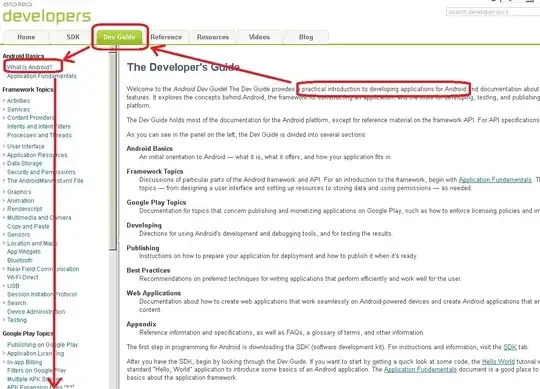
The read through sequence that looks close to learning path that worked well for me few years ago is about as follows:

  1. Open tab Dev Guide. Note the opening statement at its very beginning says:

    The Dev Guide provides a practical introduction to developing applications for Android...

  2. Read topics listed in left column one-by-one, from top to bottom
    Note dealing with hyperlinks in Dev Guide topics might be tricky. For a first read-through I would avoid side-stepping to study these, reading through as if it's plain text - but this is rather a matter of personal preference.

https://i.sstatic.net/U9hkO.jpg
While it looks obvious when you see the arrows and the relevant tab opened at above screen shot, it's not automatically clear when a newbie developer first time lands right at the http://developer.android.com.


This just suggests I drink from the fire hose...

Well thing is, introductory guides like that are designed to allow for fast study; if you feel you can't read through fast, you better learn how to do that.

  • One can use this very Android guide to practice that skill. Set a reasonable time frame to complete reading - say something like one week or less. Set a realistic goal - "to become an expert in 3 days" won't do. Aim for getting a big picture, for understanding where to look for details on various topics one may need in future - stuff like that. Then, well, start reading guide topics, one-by-one, from top to bottom - trying to keep up with time frame set.

It is very unlikely that Android will be the only technology you'll need to learn through your career. There will be many others ahead.

Being able to recognize beginner's guides and quickly read through these will bring you a serious advantage in the long run. This will let you to quickly start working with new technology while other guys around will still be complaining about fire hoses and waste time looking for a royal road which indeed lies in front of them.

gnat
  • 20,543
  • 29
  • 115
  • 306
2

Well here's the steps that I took (granted I like to jump in over my head which from what I gather isn't exactly your way of doing things):

  1. Google around
  2. Keep getting directed here: http://developer.android.com/guide/topics/fundamentals.html
  3. Get about half way through, then get ADD. Back to google. Before you do the same, have a gander at 'The AndroidManifest.xml, Activities and all of its subpages, and User Interface and all of its subpages
  4. Find some tutorials: (google it. Hackaday and ActiveFrequency had some decent ones, but there's some stupid two hyperlink rule here or something, so I can't link them)
  5. Feel ready to start work on an app
  6. Start programming
  7. Get confused
  8. Find answers on StackOverflow and other similar sites
  9. When I get one part of the app working and move on to the next, check the appropriate section in http://developer.android.com/guide/topics/fundamentals.html to try to find anything that could be relevant.
  10. At some point, realize that I did everything wrong with my first app and move on to another.
1

The community college I attend actually has a course in learning how to program in Android. We're learning the basics (and some advanced) of Java first and then moving on to Android. The textbook does a pretty good job of explaining things and, to my knowledge, is one of the only Android Programming textbooks out there. Here is a link to it at Amazon: http://www.amazon.com/Android-How-Program-Series-ebook/dp/B007HDPSAU/ref=pd_rhf_ee_p_t_3

I have the ebook for my iPad. Maybe a textbook could help you! It has some Self-Assement questions (and their answers). Good luck :)

0

After going through the developer site I believe that my original premise is correct. If you want a clear (guided even) overview of the topic, use some other source first.

I was able to use Android Boot Camp 2012 to get an overview of the topic. (Of course, it's not that great for reference back to later)

After that, I'm better able to read what's on the developer website and put the pieces into a good context.

Paul
  • 730