I would like to draw a UML sketch to communicate part of a software but the type of relationship between classes does not seem very clear cut to me.
Let's say I want to periodically fetch the recent orders from the database and update a graphical view that has the order details.
This is a highly simplified pseudo code example but my implementation is java
//Order objects contain information about a single order
class Order
{
    private String orderNumber;
    private String buyerName;
    public Order(String number, String name)
    {
    //initialize fields
    }
    //public getters
}
now I have a class called Model that has a single static function for fetching orders in a time frame:
class Model
{
    private Model()
    {}
    public static List<Order> getOrders(LocalDateTime from, LocalDateTime until)
    {
    //...get order objects from database and return
    }
}
Model.getOrders() is accessed by my Controller class which is in charge of fetching Order objects and updating a view periodically
class Controller implements Runnable
{
    private RecentOrdersView target; //view to update

    private Controller()
    {
    }
    public Controller getInstance(RecentOrdersView input)
    {
    //...singleton
    //compose the returned object with the view, so it needs which view to update
    }

    public void Run()
    {
    //... client code runs this function periodically
    List<Order> recentOrders = Model.getOrders(...);//get Orders

        for(int i=0; i<recentOrders.size(); i++)
        {
         target.updateView(recentOrders.get(i).getOrderNumebr(),
                           recentOrders.get(i).getBuyerName());
        }
    }

}
As you might have guessed there is a class for my view as follows:
class RecentOrdersView
{
    private RecentOrdersView()
    {
    }
    public RecentOrdersView getInstance()
    {
    //...singleton implementation
    }

    public void updateView(String orderNumber, String buyerName,...)
    {
    //...update the view based on the parameters
    }
}
so the controller and the view are implemented as singletons, but the model is accessed through public static function. Client code is responsible for putting it together:
class Client
{
    public static void main(String[] args)
    {

    RecentOrderView view = RecentOrdersView.getInstance();
    Runnable controller= Controller.getInstance(view);
    //schedule controller to run periodically
    }
}
Now I want to create a UML diagram for this setup, however I don't know if I should use aggregation or composition between Controller, Model and Order
my best guess looks like this: 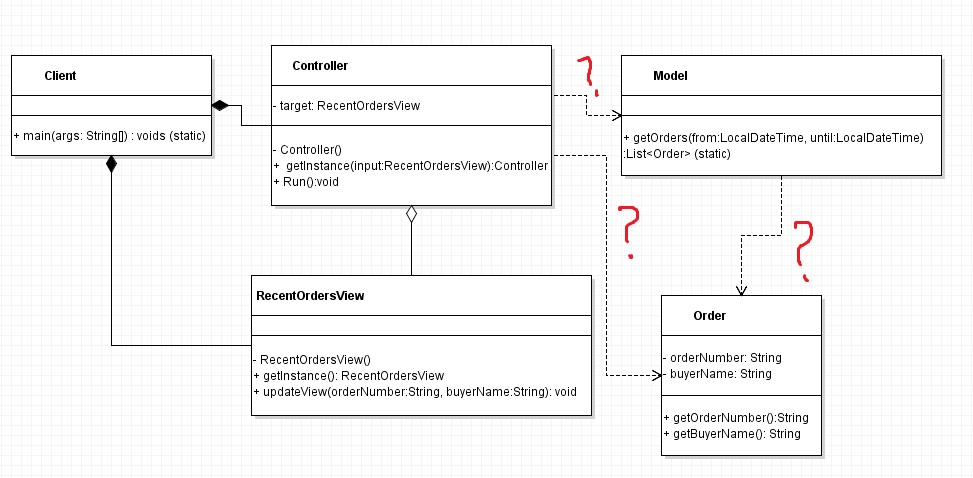
I have selected composition relationship between Client and RecentOrdersView and Controller, because Client owns an instance of each. I have also selected an aggregation relationship between RecentOrdersView and Controller, because Controller holds a reference of RecentOrdersView (even though it does not own it).
where I am confused is the relationships between Order, Controller and Model. Specifics:
Relationship between Model and Controller:
I know that Controller calls a static function in Model, but since there is no object instances, I am unsure what to do
Relationship between Model and Order: I almost want to use composition because Model instantiates Order objects, but since this happens in a static function there is no immediate owner, the Order objects get passed back to Controller
Relationship between Controller and Order:
inside Controller method Run() is where Order objects fall out of scope, but Controller object is not the one that directly instantiated those objects. should I be using composition here?
Thank you for reading this long question. I also highly appreciate advice about the overall design pattern used.


