50

I learned very early on that cutting & pasting somebody else's code takes longer in the long run that writing it yourself. In my opinion unless you really understand it, cut & paste code will probably have issues which will be a nightmare to resolve.

Don't get me wrong, I mean finding other peoples code and learning from it is essential, but we don't just paste it into our app. We rewrite the concepts into our app.

But I'm constantly hearing about people who cut & paste, and they talk about it like it's common practice. I also see comments by others which indicate it's common practice.

So, do most programmers cut & paste code?

gnat
  • 20,543
  • 29
  • 115
  • 306
John MacIntyre
  • 5,750
  • 4
  • 35
  • 48

13 Answers13

48

Two general cases:

From one project to another:

Most programmers cut and paste code in this capacity. They might find a previous project or something online and copy/paste it exactly or copy/paste and make changes to it. I think this practice is typically fine. This is especially good when it is proven code. (Examples: Some sort of utility object from a past project that worked well, or possibly from a blog with few changes needed). Where this can be bad, is when you are copying code that you don't understand, or where the code is poor, or where there is a much better alternative solution than the code that you are pasting.

Inside the same project: Copy and pasting in the same project is typically not a good idea. This is a bad smell that the code that is being copied should just be in a method/class somewhere and called repeatedly. There are some exceptions to this, but generally the programmer should be thinking: "Is there a way I can parameterize this code that I am copying?".

niahoo
  • 101
jzd
  • 4,176
37

Most programmers do it, but that doesn't mean you should

One of my programming mantras is: "If I am copying and pasting code, I am doing something wrong". Essentially, DRY.

I think it should be obvious that code reuse means using code as a resource, not repeating code. Sometimes I've copied and pasted code my own code, on most cases I end with boiler plate code or stuff that looks really similar.

After investing some more time with that code afterwards I end up with the following:

  • A component (see also: separation of concerns)
  • I can resort to reflection to make things simpler, cleaner and more easy to reapeat in the future.
  • A better design, because even if it works, why not do it all over again after you learned the lessons?.
  • A pattern that I can abstract, turn into a library component, and remove duplicated code.

It can be debatable whether we should or shouldn't copy & paste code since the client/boss doesn't care (at least directly and in the short term) and you might end with the same results, but the problem really comes when it leads to bugs, loss of modularity, and ultimately, maintenance hell.

What you should do: refactor ASAP

Nobody writes perfect code, even if it works, even when you are not copying & pasting and it is your own code, if you are not quite satisfied with it just put a note in comments (e.g. a docblock "@todo") to remind yourself what to refactor and why... even if you don't refactor it yourself, it might become the difference between happiness and total frustration for the maintainer.

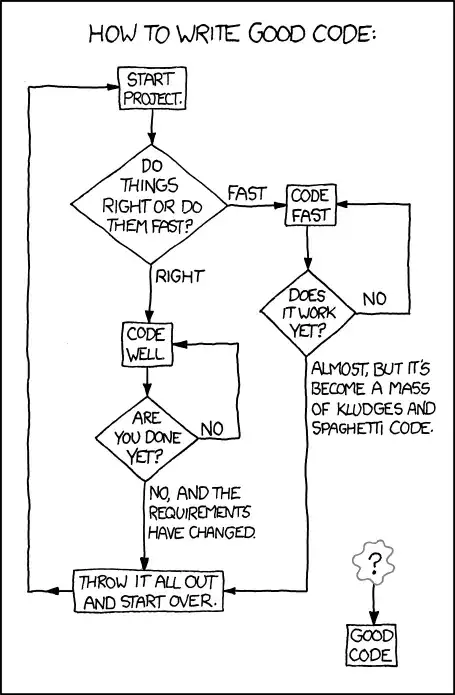
Eventually, you'll end with good code in the end, even if you copy and paste.

Good Code

via XKCD

dukeofgaming
  • 14,023
  • 6
  • 52
  • 77
8

When I'm stuck and search for stuff to solve my problem and happen upon some helpful snippet of code that does what I want, I naturally copy it. Sometimes it's just the gist of it. I then change it to suite my needs. This happens more often when I delve into things that I am not an expert in (currently, Objective-C).

I always take the time to learn something from the code, so for me it's a great way to learn and to avoid reinventing the wheel.

6

I'm going to talk about copy/pasting other people's code here. Grabbing parts of my own work from my personal library is fair game. I know them and understand them by definition.

I find that the most frequent situation where I "cut & paste" code is when I have a particular problem and I run into a blog post that solves it. Most times I retype the solution into my project (after all, it's probably written in the blog author's style, if nothing else). It's not really my code, but I don't feel bad about using it in that scenario.

Going out and grabbing entire methods or systems to paste them into my project as-is and call it done is something I don't understand. There was a question on StackOverflow the other day that perfectly illustrated the problem with doing something like that.

Cobbling together a Frankenstein monster out of different code parts just can't be all that efficient. I mean, if you get good at it, that means you're either replicating the same solution over and over again or you've obtained enough understanding of other people's code that the same level of copy/pasting should no longer be necessary and your productivity would improve through not having to resolve issues between incompatible code samples.

I personally have not met many programmers who copy/paste on a large scale. I've seen plenty who code themselves into the deepest and darkest corners, but that's a different story. Based on my personal anecdata, I'd say that most programmers don't copy/paste entire applications together, but it's really hard to say for sure.

Adam Lear
  • 32,069
4

As a new programmer (4 months into my first job), I rely on help quite a lot (whether from SO or other places). I make a point of NOT blindly copying and pasting others code. Even if the code provided is what I will be using, I will type it into my program and then spend a little time making sure I completely understand what it does and the reasons for it.

I want to ensure that I am constantly learning and not simply an expert in cut and paste

Darren Young
  • 2,175
4

Bad: Copying and pasting the same block of code over and over again

If you find yourself doing this, you should probably take a second to think about what can be abstracted out of the code being copied and create a function/method to handle it. This is where the DRY (Don't Repeat Yourself) principle counts.

Good: Copying a block of code that's known to work

DRY (Don't Repeat Yourself) also applies here, just in a different sense. IE, don't repeat work you've already done in the past. If you have taken the time to write a section of code, debug, test it, and it's proven to work in a production codebase; you'd be dumb not to re-use it.

Most people give copying-pasting a bad rap because many beginner programmers spend their time scouring the net and copying/pasting a mishmash of other people's code without understanding what it actually does.

Writing everything from scratch every time isn't any better. I know there are a lot of old school purist programmers that thing everything should be written from scratch and I hope I don't get stuck working with them. If you have 5 years of programming experience, you should have a pretty substantial library of code that's prime for re-use. It's one of the best assets an experienced programmer can bring to the table because it'll potentially save a lot of development time.

If you don't understand with your old code does at first, take a moment to read the comments and re-familiarize yourself. If your comments suck... well, that's another issue altogether.

Evan Plaice
  • 5,785
3

After 25 years of writing code, there have been times when (with no access to code I wrote for a previous employer) I've wished I could cut and paste. HOWEVER this has been very rare (and keep reading).

Perhaps the best example is a really simple command line parser I came across years ago for unix operating systems. A simple loop zipping through the args and processing the options. It was devlishly simple and elegant, and I've used that (more as a pattern than as a literal cut and paste) many times since. This is the exception rather than the rule.

Usually a plain ole cut and paste is completely inappropriate - its more cut and paste the concept, or algorithm, that has been important.

I'm not too proud - I'll happily search around to find a really fast parity or hamming code verify algorithm or something exotic like that. Then spend a few hours understand it to see if it really is the massively super-fast thing I was after, or a naive pile of junk.

I worry every time anybody merely copies code without pausing to understand it. They are either a genius (understand it and all its subtleties in a glance), or a fool. There's not much room for anything in between. Oh, and there are not many true geniuses either.

Without understanding, you really have no idea what you've just thrown in REALLY does, under not just the happy but also the unhappy circumstances or input conditions. Sometimes this does not matter cos you get lucky. And sometimes this makes for much long term pain.

quickly_now
  • 15,060
3

There is a common situation where you basically NEED to do it to be productive.

Any technology unfamiliar to you is hard to learn unless you have a working example to start with. Hence you copy and paste that to have something that actually runs, and then start tinkering with it.

1

Given that, in one open source repository, 15 % of all methods are copied from one project to another (pdf), the answer seems to be a clear yes.

John MacIntyre
  • 5,750
  • 4
  • 35
  • 48
nes1983
  • 149
1

I have so many feelings about this topic, and I can't honestly say any of them are entirely objective.

There are many arguments for cutting and pasting other people's code into your application. Some of them may make sense, some may not. For instance, if you've got a method from someone's blog that takes an input and runs some complicated mathematical algorithm that's way outside your mathematical abilities and spits out a result - that's an argument for cutting and pasting - get the author's permission to use their code and credit them where due - it's the honorable thing to do.

There are arguments for not reinventing the wheel - again, this makes sense, in theory. But if you don't take the time to become intimately familiar with the code you're cutting and pasting, you don't know if there's a better way of solving this problem, you don't know if there are bugs in the code. What if the wheel you're pasting is broken?

There are arguments for speed and efficiency - you build up a library of other people's code that you've ripped off, stolen, plagiarized or otherwise, come to think of it, you may never even need to know how to program beyond Frankensteining some application together out of reclaimed parts.

There are times and places where I deem this behaviour completely acceptable. For hacking together quick throw-away tools that aren't designed for longevity but to get a task done, right now by hook or by crook. For the purpose of prototyping and studying concents, to learn and advance in a theoretical context I think this is completely fair game.

Cutting and pasting other people's code is plagiarism - if you have their blessing and you understand the code you're pasting and it fits within the construct of the coding standards for your application, then fine, I will concede it's fair game.

As a professional software engineer, I am being paid to maintain a standard and a code of ethics. I'm not being paid to steal, plagiarize or infringe on other people's copyright putting my client at risk of prosecution. Aside from this, there is a very real risk that when you run said cut/pasted code it has catastrophic side effects.

Not targeting this answer at you John, I know you're very ethically inclined when it comes to topics like this, so this is really just a general rant in the direction of the question itself.

Addendum: That said, I feel that cutting and pasting your own code between projects is quite acceptable - unless it was written as work-for-hire for someone else, in which case you don't own the copyright and you should get the permission of the person you coded it for. I've found that unless the code is pertinent to proprietry functional concepts, most employers are okay with you re-using your own ideas for other clients.

BenAlabaster
  • 1,079
  • 1
  • 10
  • 8
0

In most cases, code that you'll find on the net won't fit your exact purposes.

What is see myself doing a lot is copying code from someone, stripping it down to the very essence and then adding code till it meets my requirements. I'll always refactor it to match my naming conventions and coding style.

I personally hate it when I read a tutorial and they start by showing code for a complicated case. Start with the essence and show building blocks to extend the code. If I ever start an own blog, I'll provide people with a commented code example which shows the essence of what I want to do, how you can add functionality/special cases and a fully working example of the basic feature.

J. Maes
  • 437
0

If the code is good then instead of copy and paste it should be made into a common library. But people can't be bothered with refactoring and they prefer to have same functionality spread by copy and method.

Instead of having a universal absolute law of copy and paste is good or bad, one should see when to use it.

The pros for copy and paste are : Gets you going fast Cons are : Same code is spread in multiple places and any problem found/solved needs to be solved everywhere, if instead of copy and paste one used it as common library then the update will propagate everywhere. For a small initial investment of using a library instead of spreading the same code everywhere manifolds.

The choice is to whether save a little time initially compared to a lot later, then copy and paste is the way to go, otherwise refactore and put it in a common library.

jimjim
  • 863
0

I find that "integration" team members or those that don't have as much experience with code or in programming tend to copy & paste more often and not understand what they did (getting into the problems mentioned in your question).

I also find that programmers often stay away from cut & paste to their own chagrin because they love code and often reinvent the wheel, just because they want to do it better or learn more.

John K
  • 1,406