31

Context

I am looking for work as a contractor in my field of expertise and would prefer to earn less money and have less benefits working as a short-term contractor.

The problem:

Companies say I need to be an in-house employee for intellectual property reasons.

The question:

Wouldn't it be easy for them to just have me sign a contract saying all my work is owned by them?

If I work as a contractor, they can let me go when my value diminishes and save lots of money.

What am I missing here?

b_dev
  • 410

12 Answers12

48

It's cheaper

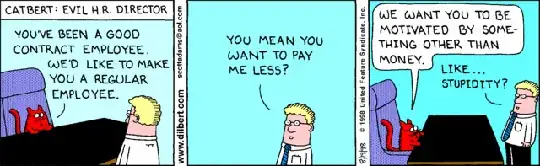
Hiring people is generally much cheaper than normal contractor rates, not many companies will come out flat and say this though so they state a number of "non-reasons".

enter image description here

Homde
  • 11,114
30

Hmm. From the question it appears you want to be a consultant, not a contractor. You want to go to a company, give them the benefit of yout specialised expertise and then move on to the next.

From my knowledge of how businesses work, what you want to do is set up a consulting company that can be hired to present your knowledge to the company and then be hired to transfer that knowledge to the company's employees. Companies like this - they get better trained employees rather than spending money on the same skills that would then leave the company.

The benefit to you is that you get to charge loads more - consultants are expected to be expensive, and worth every penny (even if really, they're not, trust me on this). The disadvantage to you is that you have be more professional, you have to provide a service (of education) as a company selling something rather than a person popping in for a month or two to have a few chats. That means you'll need to formalise your training in powerpoints and white papers and thick bound reference manuals.

The latter is probably not as much fun, but then.. I got to tell you, work generally isn't.

gbjbaanb
  • 48,749
  • 7
  • 106
  • 173
18

You'll run into this frequently, depending on where you live and where the company lives.

The first thing we need to do is disassemble the term intellectual property. You have:

  • Copyright
  • Patent
  • Trademark

Lets look at these things individually.

Copyright

Under normal employment, depending on what you sign, your employer owns your output, sometimes during off hours. That is not the case when you are contractor, as you are a vendor that owns the copyright unless it is specifically assigned. This can be a managerial headache that many companies want to avoid.

Patent

I hate software patents, with a passion. However, if you come up with what decision makers deem to be a patentable process for 'doing something', the company needs to own it first. That brings us back to copyright.

Trademark

This isn't really a key issue. Many companies furnish their logo to be printed on devices, literature, etc to third party vendors that produce devices and literature. However, we get back to administrative stuff, you need (in many places) explicit written permission to produce builds that contain trademarked media (text, logo, etc).

This is all solved by hiring employees and not worrying about holes in a master contractor agreement, project specific agreement and how any of the above might nullify your existing NDA. Remember, project contracts do tend to change often due to scope creep. This is the work of lawyers, who cost money, and they'd probably rather save that.

If you live in another country, under a different legal system, the potential problem multiplies, when in fact it's probably a null scenario.

In reality, seldom do these problems actually surface .. but they could and that's what guides policy decisions.

You can't hate the world for what it is, all you can do is work around it.

7

"Intellectual property" aside, there are other very good reasons not to take on an expert who can leave on a whim.

Let's take you out of your comfort zone. Imagine you run a company that has decided to start a new project researching the genetic makeup of a particularly obscure virus. What you personally know about this virus could be written on the back of an envelope, so you hire a PhD graduate to work on the project. The graduate has very in-depth knowledge of this virus because he studied it as his PhD research topic.

The chances of you finding another graduate like him are tiny. You really need someone who is a domain expert in this very specific field. He wants to be taken on as a contractor so you hire him.

Six months into the project. You've spent a few hundred thousand dollars so far. Your graduate contractor decides he wants to leave. Tomorrow. The project isn't finished. It's too far along to scrap without taking a massive loss and you can't find anyone to replace him.

If only you'd have the foresight to hire him as a full-time employee.

Ant
  • 2,588
5

I'm fairly sure the main reason we prefer full-time employees over contractors is that we pay them less...

jk.
  • 10,306
4

If it's cheaper or not is arguable (total cost of full-time employee is 2-4x his salary).

I'd rather believe it's about loyalty or rather how corporation middle management perceives it. Many managers think if someone is full-time employee, then he's "part of the team", thus automatically loyal forver to the corporation. On the other hand the perceive external contractors as the name indicates — something external. Also full-time contract most often means exclusive contract, while external contractors might have other clients. Generally middle managers perceive full-timers as more stable option.

Of course this is logical fallacy. Actually it's much easier to get guarantees from contractor, than full-timer. In fact most countries have laws protecting employee rights, but not really contractor right. So employee may leave, and company can't do anything about it, on the other hand contractor usually has no easy way of terminating his contract short. Also non-competence contracts in many countries have been deemed to have no legal value in case of employees, but they still apply to contractors.

vartec
  • 20,846
3

Besides intellectual property their are also tax concerns to deal with independent contractors. If you are going to hire a contractor they need to be treated like a contractor and not an employee. The employer looses a fair bit of control in the when and how things get done with a contractor versus an employee.

Also a disgruntled contractor can always come back later and try to claim they really should have been an employee and the state department of labor or the IRS will audit the company. If the disgruntled contractor wins they get the employer half of FICA taxes and the employer owes taxes, penalties, and unemployment insurance. The differences between employee and contractor are particularly vague making it hard for a company to know if they are in fact complying with the law. It is easier to default to hiring employees than to hire contractors that may be questionable. If you only do business with one company, work from their office, using their equipment the company is going to have a very hard time defending their decision to classify you as a contractor rather than an employee.

Some more information from the IRS on contractors versus employees.

stoj
  • 249
2

I've been a contractor all my life (In the UK). I've literally never had a 'real job'.

Companies have always asked me to go permanent for them, and they've always tried to come up with reasons to do with intellectual property and long term loyalty.

And I've always said "OK, as long as you pay me the same". Which tends to end the conversation.

Just once in my whole life, that has also been the end of the contract, although even then the option was still open to become a permanent employee (at about half the amount they were paying me as a contractor). I think the company in question really needed to cut its budget.

Now I am old, a lot of my friends have gone into management. I've asked them why companies always try to get their contract staff to go permie. To a man they say "It's because it's much cheaper".

If the real reason was anything else, then they would be prepared to pay you more as a permanent employee than as a contractor. Because you'd be worth more to them.

It's just part of the negotiating game. Stick to your guns. If they can find someone of your quality willing to go permanent then they may replace you with him, and fair enough. But good people are thin on the ground, and the longer you've worked for them the harder it will be to replace you.

Unless they're about to go bust, if they find someone good, they'll employ him as well as you, because in any company that's not about to go bust, there's always more work than there are people to do it.

Since they've broken the ice and started talking about money, why not ask them for an extra £5/hour? Remember it's only a game. No one will take offence if you play too.

Also talk to some friendly purchasing people, or if you've got friends who are managers at other firms talk to them. They can explain how to play. In the worst case buy a book about negotiating. "Getting to Yes" is good, and a bit of a classic. Negotiating is great fun, and not at all the scary thing most people think it is.

And business is all about negotiation. If you negotiate well and in a friendly and decent manner, you'll get nothing but respect for it. If you play the game badly or spitefully, you'll just get classified with all the other clueless losers.

Honestly, if you play chess with someone and they keep losing their queen by making terrible moves, do you think 'Hey, he's loyal. I want him on my side?'

2

While it's certainly possible that cost, not intellectual property, is really the driving issue, there are cases in specialized fields where there are substantial intellectual property issues.

How close is your specific area of data analysis to what a company would regard as core to their business or key to their competitive advantage? How likely would the analysis you do for one company inform your future analysis for its biggest competitor?

If you were an expert in, for example, data analysis to provide recommendations to shoppers, it would be very unlikely that a company like Amazon would want to hire you on a short-term basis rather than as a full-time employee. Amazon has already invested quite a bit in this type of data analysis and would tend to be concerned that you would come in for a few months, help them improve their recommendation engine, but also end up absorbing a lot of their existing tricks and discoveries. That would make you particularly attractive to competitors to Amazon that have much less invested in recommendation engines and would potentially erode Amazon's existing competitive advantage. If they hired you as an employee, on the other hand, it would generally be much easier to restrict you from working for a competitor doing the same thing for some time.

If this is really their issue, you could potentially negotiate that sort of non-compete agreement with the companies you do work for. But that would require some good lawyering to ensure both that you don't end up in a situation where you can't legally work for anyone for a period of time and that the company doesn't end up in trouble with the IRS for treating you like an employee while paying you as a consultant. On the other hand, companies may just feel more comfortable ensuring that only employees have access to their "secret sauce".

Justin Cave
  • 12,811
2

I suspect 2 possible situations

  1. Non-compete
  2. The W2 vs 1099 situation.

Non-compete My suspicion is that they want you to sign a non-compete agreement. Depending on which state you are in, and which state the company is headquartered in, non-compete agreements might be worthless (such as in California) or they might have vicious fangs (such as in NY or OH). Non-competes are quite common for employees and most companies make them a requirement of employment. No consultant or contractor would sign a non-compete agreement.

Up until the 1970s, it was quite common for a non-compete clause to last 10 years after termination of employment. Since then, such contracts have been whittled down to about 1 year.

Signing one might mean that you can't work for a year if you quit working for them - if your research is "hot stuff". It might also mean that they can prevent you from working for their competitor and that hiring you as an employee would be the cheapest way to deny their enemy of your expertise.

The quickest way to determine if this is the reason that they want you as an employee would be to say "OK, I'll be an employee, but I refuse to sign any non-compete clause".

W2 vs 1099 Doctors, lawyers and accountants may set up "professional corporations". The Tax Reform Act of 1986 added restrictions to make it almost impossible for programmers and engineers to do so (if you remember the guy who flew his plane into an IRS building last year, this was what his complaint was about). This means that if you want to be a contractor/consultant as well as a programmer, you'll need to be an employee of some other company. The rules for being a 1099 contractor for engineers and programmers are strenuous enough that the vast majority of companies can't be bothered to figure them out - so they flat out don't bother and require you to be a W2 employee of some other company.

Tangurena
  • 13,324
1

This is a bit of a tangent, but - part of the reason why some companies want all fulltime employees is because their projects are a (long term) mess.

The only way things get done (and maintained) is by having people around who've been there forever and know the Big Ball of Mud (and the huge "inner platform") inside out. I've worked at companies where the ramp up time to learn the beast and get comfortable with it is as much as 12 months or more. In this scenario, it makes sense to find stability-oriented people who will stick around and put up with the beast forever. Simply because whenever anyone leaves - the ramp up time for a new warm body to get productive is so expensive.

I don't know how this might relate to your specialty. Maybe the companies you are approaching think they could use someone with your specialty on staff forever, rather than to just solve a one-off problem. But this is a rather typical case: companies often want a huge manifest of fulltimers (perhaps even ALL fulltimers) because their stuff is too hard to pick up for a shorter term stint. And once they have someone on the hook they want to keep them.

(Even more tangentially - I now think of this as a job smell. If I hear in a interview that "there is a lot to learn" and that there is a massive ramp up time at the shop, I'm out the door. Unless of course, there is some very very specific domain-based knowledge to learn, but definitely not just orientation with the programming side of things itself.)

Bobby Tables
  • 20,616
0

I suspect that this is very frequently NOT about either "the money" or "intellectual property", I suspect that it it frequently more about your committment to that company and your loyalty.

As a full-time employee, generally you (not necessarily YOU but generally...) are much more likely to become connected and attached to that company. Your are more likely to dedicate yourself to the mission of the company not just "code for this week".

You are more likely to be more invested emotionally and/or financially when you are an employee and the future of the company is about the future of your employment and working conditions and not just about "this months work".