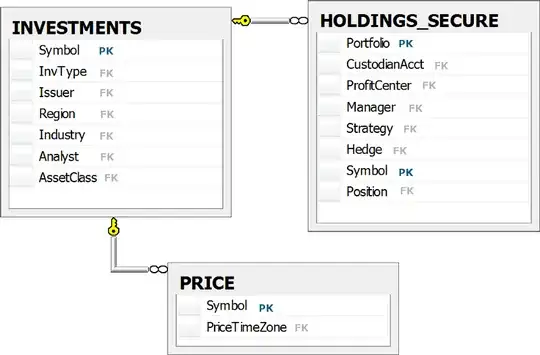
It could be that the aggregations fit better in a subquery, and make more sense when it's that subquery that's later joined to the other table INVESTMENTS and PRICE-see below.
In that case you could say that the "reason" for it could be:
- developer inexperience w/ SQL
- developer experience gained on SQL platform that doesn't support table subqueries
- developer style
It could be that some data in the tables is not normalized properly, or something similar as suggested in other comments, or it could be just plain wrong.
Here's a guess as to how perhaps it could be re-written more neatly with a subquery, followed by a another query that might help analyze the data for anomalies if that turns out to be necessary.
possible rewrite:
SELECT
    I.Symbol Symbol
,   I.Ticker CUSIP
,   I.Name Name
,   H.Quantity TotalQuantity
,   H.MarketValue TotalMarketValue
,   H.PriceLC Price
,   I.CategoryCode5 BUY_SELL
,   I.EquivFactor1 PriceTgt
,   P.LastPrice CurrPrice
,   I.AssetClass Target
,   I.Industry Industry
,   I.CategoryCode1 Risk
FROM (
    --begin holdings_secure_aggregated
    SELECT
    Symbol,
    SUM(Quantity) TotalQuantity,
    SUM(MarketValue) TotalMarketValue,
    MAX(PriceLC) PriceLC
    FROM HOLDINGS_SECURE
    WHERE Quantity > 0
    GROUP BY Symbol
) H, --end holdings_secure_aggregated
INVESTMENTS I, PRICE P
WHERE
    H.Symbol = I.Symbol
    AND I.Product = 'stock'
    AND I.CategoryCode5 NOT IN ('X', '')
    AND H.Symbol = P.Symbol
GROUP BY I.Symbol;
You can use something ugly like this to see which I.Symbol values-if any-return more than one distinct value among the columns that are aggregated using MAX, and to see precisely what those individual values are.
SELECT
    I.Symbol Symbol
,   I.Ticker CUSIP
,   I.Name Name
,   H.Quantity TotalQuantity
,   H.MarketValue TotalMarketValue
,   H.PriceLC Price
,   I.CategoryCode5 BUY_SELL
,   I.EquivFactor1 PriceTgt
,   P.LastPrice CurrPrice
,   I.AssetClass Target
,   I.Industry Industry
,   I.CategoryCode1 Risk
FROM
    HOLDINGS_SECURE H
,   INVESTMENTS I
,   PRICE P
WHERE
    H.Symbol = I.Symbol
    AND I.Product = 'stock'
    AND H.Quantity > 0
    AND I.CategoryCode5 NOT IN ('X', '')
    AND H.Symbol = P.Symbol
    AND EXISTS (
        SELECT I.Symbol
        FROM
            HOLDINGS_SECURE H
        ,   INVESTMENTS I
        ,   PRICE P
        WHERE
            H.Symbol = I.Symbol
            AND I.Product = 'stock'
            AND H.Quantity > 0
            AND I.CategoryCode5 NOT IN ('X', '')
            AND H.Symbol = P.Symbol
        GROUP BY
            I.Symbol
        HAVING (
            COUNT(DISTINCT I.Ticker)
            + COUNT(DISTINCT I.Name)
            + COUNT(DISTINCT H.PriceLC)
            + COUNT(DISTINCT I.CategoryCode5)
            + COUNT(DISTINCT I.EquivFactor1)
            + COUNT(DISTINCT P.LastPrice)
            + COUNT(DISTINCT I.AssetClass)
            + COUNT(DISTINCT I.Industry)
            + COUNT(DISTINCT I.CategoryCode1)
        )
        > 0
    );