Let the circuit be:
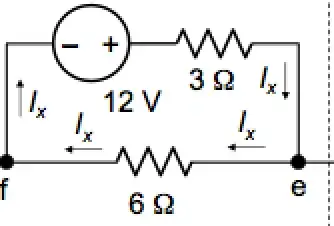
Question: Find Ix by applying KVL.
Correct Answer: Starting from node ‘f’ and going clockwise, KVL gives: 12 – 3Ix – 6Ix = 0, so that Ix = 12/9 = 4/3 A.
Problem: This seems to be a bit confusing. According to my knowledge, we can choose the signs of the resistor and we'll have the same answer.
It seems that the answerer picked those signs + --3Ω-- - and - --6Ω-- + . When Ix passed through the negative pole of the battery, we gave a (+) sign, when Ix passed through the positive pole of 3Ω and 6Ω, we gave a (-) sign.
I picked those signs. - --3Ω-- + and - --6Ω-- +. Starting from node ‘f’ and going clockwise, KVL gives: 12 + 3Ix – 6Ix = 0, so that Ix = 12/3 = 4A (the correct answer is 4/3 A).
Question: why the answerer chose the signs of the resistors this way? Why is the answer 4A wrong and 4/3 A correct? If it has to do with the passive sign convention, I would appreciate if someone would explain it to me?

