5

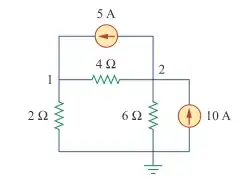
What is the best way to know the proper direction of current? Lets say we have this circuit below:

unknown directions

The correct directions are given below:

enter image description here

What are your techniques to know which is the proper way? I'm afraid that if I choose the wrong direction, then the results will be wrong.

Bill the Lizard
  • 264
  • 4
  • 15
vvavepacket
  • 2,503
  • 9
  • 41
  • 57

3 Answers3

10

No, the result won't be wrong. If you would have chosen the wrong direction the result will be negative, that's all.

It's not always easy to know in advance what direction the current will flow. Don't worry about it, just choose an arbitrary direction. Just make sure that you document your choice by drawing an arrow next to each branch.


As a matter of fact, when you solve the problem with the assumed current directions you'll find that one of the currents is negative, so its direction was assumed wrong.

stevenvh
  • 145,832
  • 21
  • 457
  • 668
3

To illustrate just how arbitrary the reference direction of a current variable is, draw another arrow next to and in the opposite direction of \$ i_1\$ and label it \$ i'_1\$.

Now, note that it doesn't matter which current variable, \$ i_1\$ or \$ i'_1\$, you solve for since we have \$i_1 = - i'_1\$.

Of course, both variables label the same current. For a physical "picture" of what these circuit variables are, think of \$ i_1\$ and \$ i'_1\$ as the respective measurements of two ammeters connected in series with that branch but connected with opposite polarity.
Alfred Centauri
  • 26,630
  • 1
  • 25
  • 63
0

It's nothing wrong in answer but you get in negative value it means current direction is opposite to assumed direction. It can be assumed any direction but requires good knowledge of analysis for exact directions. This problem can be solved in 3 methods:

  1. mesh analysis
  2. mesh using current directions
  3. node analysis

https://i.stack.imgur.com/7VSWm.jpg

Jakub Rakus
  • 2,235
  • 5
  • 19
  • 26
Prabhu MD
  • 1
  • 1