21

Why do we design cars to turn by turning the front wheel?

Wouldn't it better to keep all wheels straight and turn by rotating the wheels on one side of a car more then the wheels on the opposite side of the car, like tank tracks do? That way you can turn even if you are standing still. Why don't cars do this?

Fred
  • 9,782
  • 13
  • 36
  • 48
Mustafa
  • 333
  • 2
  • 5

7 Answers7

19

If you were going to turn left 90 degrees, without turning the wheels, then you wind up dragging the wheels sideways while you turn. 16 seconds into this video shows exactly what I'm talking about.

So every time you try to back out of your driveway, or a parking spot, or turn into a parking spot, or turn anywhere for any reason, you're going to lay down rubber because the tires are rotating quickly while remaining nearly stationary as you turn. Again, look at the wheel slip in the video I linked.

You'd be hard pressed to find "four wheel differential steering" in use anywhere for any reason. Tanks use it to reduce the ground pressure they exert so they don't sink in the dirt. Cars aren't going to sink into pavement so this isn't an issue.

Chuck
  • 3,575
  • 15
  • 32
7

While it might be possible to design a rear-wheel-drive car in such a fashion that the front wheels basically operated as casters and the steering was controlled by driving the rear wheels at different speeds (some automatic guided vehicles operate on this principle), such vehicles perform poorly when there is a loss of traction at speed. If such a car were accelerating when the left rear wheel lost traction, the car would immediately start rotating to the left, and would likely travel some distance to the left before the driver could react to the situation. Even if the car's control system used accelerometers and gyros to detect that condition faster and keep the car from going far off course, they couldn't react to the loss of traction until after it had already affected the vehicle's rotational velocity. By contrast, holding the front wheels at a driver-controlled angle will keep the vehicle going straight even if one of the wheels loses traction.

supercat
  • 379
  • 1
  • 7
7

The main reason is because when a car brakes/decelerates, the load is reduced on the rear wheels and increased on the front wheels. If your car was exclusively rear wheel steering you would lose steering in high speed braking. The converse does not occur because engine accelerations are typically much much less than braking decelerations.

Forklifts are almost exclusively rear wheel steering for more maneuverability of a pallet in the front, but they are limited to low speeds.

There are four wheel steering cars: https://en.wikipedia.org/wiki/Category:Vehicles_with_four-wheel_steering

Many of them are computer controlled and steer in opposite directions for low speed maneuverability and in the same direction for high speed strafing. None that I know of do caterpillar style rotation about the center axis.

ericnutsch
  • 8,305
  • 1
  • 16
  • 32
5

The Jeep Hurricane has four-wheel steering that allows it to pivot 360° without moving. But it's very complex and expensive.

I would guess that skid-steer systems in general are heavier, bulkier, and more complex. And really, the only place they're particularly useful is when you need really tight steering. 99% of our driving has no use for really tight steering, so it doesn't make a lot of sense to design the vehicle for the other 1%.

MichaelS
  • 151
  • 3
1

Meet the skid-steer loader:
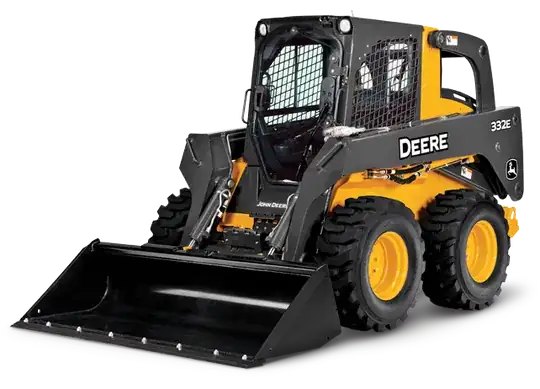
Skid-steer

It's a versatile beast of a machine, packing lots of power, multiple attachments and (most relevantly to the topic at hand) great maneuverability.

It does exactly what you suggested. It has stationary tires, which turn at different angular velocities in order to turn the vehicle, like a tank. It's easy to turn in a full circle without changing the machine's position. This gives it a number of advantages:

  • It can readjust its position when loading and unloading things, if (for example) the forks need to move a few inches to the left or right.
  • It can move a bucket sideways to smooth out dirt or gravel.
  • Its turn radius is 0, meaning it can get into tight spaces not designed for vehicles.

Compared to a compact track loader (a similar machine that uses tracks instead of tires), the skid steer has these advantages and disadvantages:

  • Lower maintenance and repair cost
  • Lighter and faster
  • Operates poorly if at all in muddy or snowy conditions
  • Affects the ground more

A car has little to no need for any of these advantages, as they're not used to load, unload or landscape (though attaching a trailer would be much easier), and generally travel on pathways designed for them.

There actually exist accessories for wheeled vehicles that provide mini tracks for each wheel, to be used in mud or snow:
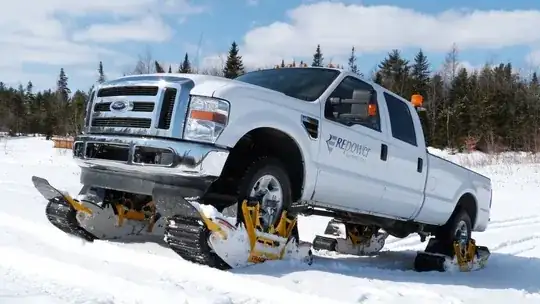
Truck tracks

But even so, the basic steering functionality is still by directed turning rather than skid steering. In fact, there are even machines that are designed for tracks that steer in the same manner:
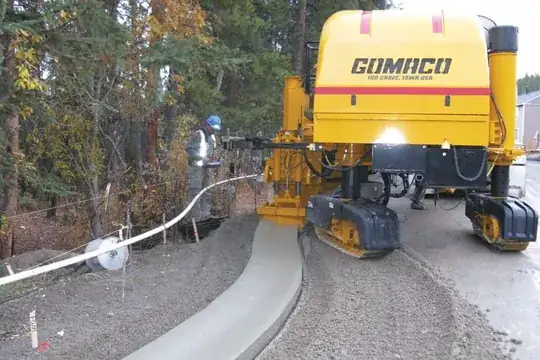
Curbing machine

If even some tracked machines steer in the same manner that cars do, instead of by skidding, there must be some advantage, right?

One advantage (the above curbing machine steers conventionally for this reason) is that it's much easier to form a smooth curve. While computer systems could be used to determine each tire's rotation speed to produce a given turn radius, it's much simpler to simply turn the wheels. Also, as pointed out by @alphazero, one is that skidding reduces traction significantly, which can lead to uncontrollable situations at high speed. There's also the matter of wear and tear resulting from the skidding (and protip, try to turn the steering wheel in your car only when moving, if practical).

In conclusion:

Cars generally steer by turning their wheels instead of skidding because few of the advantages of skid steering have much application to a car but the disadvantages range from expensive to complex to disastrous.

Devsman
  • 111
  • 4
1

Aside from the issue of tire wear on side-skidding wheels (which could conceptually be solved by using different materials for both wheels and road surfaces) the OP's proposed steering method has one huge disadvantage over "conventional" steering, and that is lack of precision. It necessarily involves a jump between static friction for straight-line driving and dynamic (sliding) friction when turning, and that "jump" will occur at an unpredictable point in time.

This is not much of a problem for military use of a tracked vehicle like a tank, but lack of precision steering when changing lanes when travelling at 70 mph on a busy highway is a very different matter.

alephzero
  • 12,578
  • 1
  • 16
  • 28
0

Some food for thought. Airtrax is an omni-directional drive system with special wheels to enable the kind of maneuverability. (I've only seen it used in low speed applications)

https://m.youtube.com/watch?v=IlmKcohyXG0

GisMofx
  • 1,588
  • 12
  • 19