2

Some trampoline springs extend only 40-50% before reaching their elastic limit. (e.g. a 10 inch spring can extend to 14 or 15 inches. Good springs can extend to 100% (E.g. a 10 inch spring can extend to 20 inches.

What is the difference?

Is this solely a matter of the alloy of spring wire used; Is it the shape of the spring?

What goes into the design of a long extension spring?

  • I imagine you would have more coils per length in a spring with longer extension since the material itself can only handle limited deformation. – DKNguyen Jul 25 '23 at 23:52
  • Obvious when you think about it. But thinner wires mean less force. Larger diameter should extend more too. – Sherwood Botsford Jul 27 '23 at 01:56

3 Answers3

4

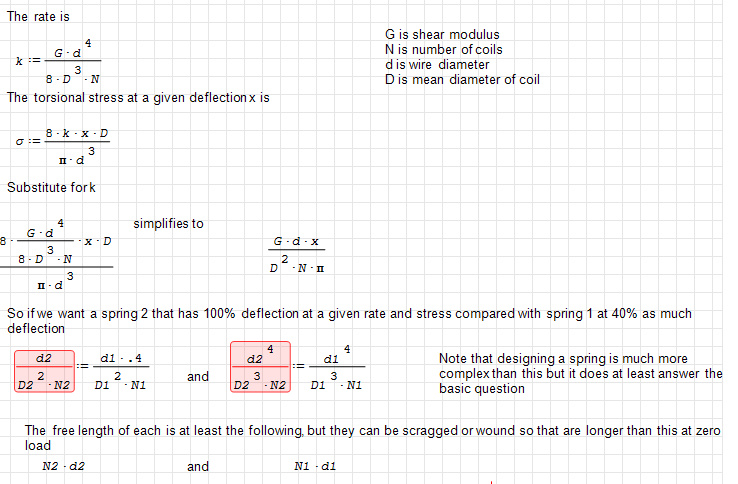
For a given free length and spring rate there are an infinite number of designs of coil spring. However, there are many practical limitations that limit the options. A spring with a few coils, of thin wire, will reach its yield point before one made of thicker wire, with many coils, even if it is the same material.

In answer to OP's comment, here's the math. Smath v4

Greg Locock
  • 1,147
  • 1
  • 4
  • 10
2

The ratio of the spring diameter to the wire diameter is the primary factor.

Phil Sweet
  • 5,224
  • 10
  • 20
1

Let's compare two springs of the same alloy but with different numbers of turns

$N_1 =2 N_2$

.

over the length of the coil, $L$

Now if we extend the coils to a length $$L=2L_{inital}$$ The coils with more turns, $N_1$ Get half deformed per turn, so they can be stretched twice deforming less.

This usually means a thinner spring wire!

kamran
  • 23,517
  • 2
  • 22
  • 42